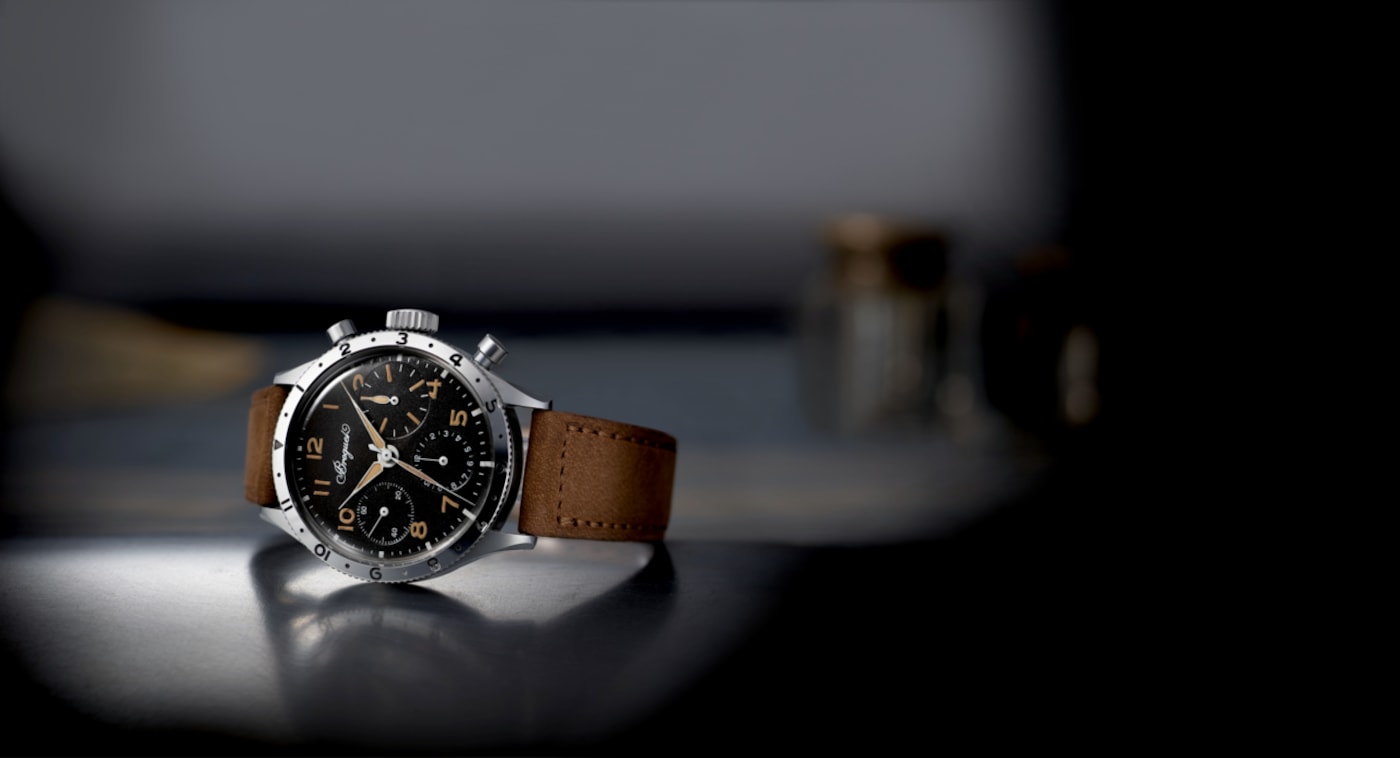

History of the Type XX, origins and first generation
by Emmanuel Breguet
It was only natural that in the early 1950s, Breguet found itself ready to meet the air force demands for a robust wrist chronograph with special features.
In the 20th century, the renowned and prestigious House of Breguet was as committed to accompanying great human adventures as it had been to maritime navigation in the 19th century. Many pilots acquired Breguet watches: Alberto Santos-Dumont in 1910, American aviators stationed in France in 1918, the Louis Breguet aviation company, Japanese pilots visiting France in the 1920s, and numerous others...
For a pilot, and more generally for an aircrew member, keeping track of time on board an aircraft, maintaining temporal references within an environment of intense activity and stress, is a vital necessity. Being able to measure flight time or intermediate flight times, monitor fuel consumption, take bearings, carry out manoeuvres etc., all this requires instruments that watchmakers would over the years render both more accurate and more convenient to handle: onboard chronographs and soon thereafter chronograph wristwatches.
A study of archives reveals that numerous “special” products, i.e. suited to the particular constraints of the aeronautical environment, were introduced from the 1930s onwards: 19-ligne aerodrome chronometers in an antimagnetic silver case, split-second chronograph counters, small 24-ligne onboard chronometers equipped with a heat-insulated case, a thermostat and lighting, siderometers... All these highly technical models were delivered both to military aviation and to the recently created national airline, Air France.
The supply of watchmaking instruments for aircraft instrument panels became more important in the early 1950s, and for 30 years was one of Breguet’s recognised specialities. The most widespread models were the Type 11, 11/1 and 12, which were sold in a dozen countries and featured on the instrument panels of numerous aircraft, notably including the unforgettable supersonic Concorde.
In the 1930s, the company was already producing more and more wristwatches with a chronograph function, and the post-war period confirmed the trend. The fashion for wrist chronographs was launched and would continue unabated.
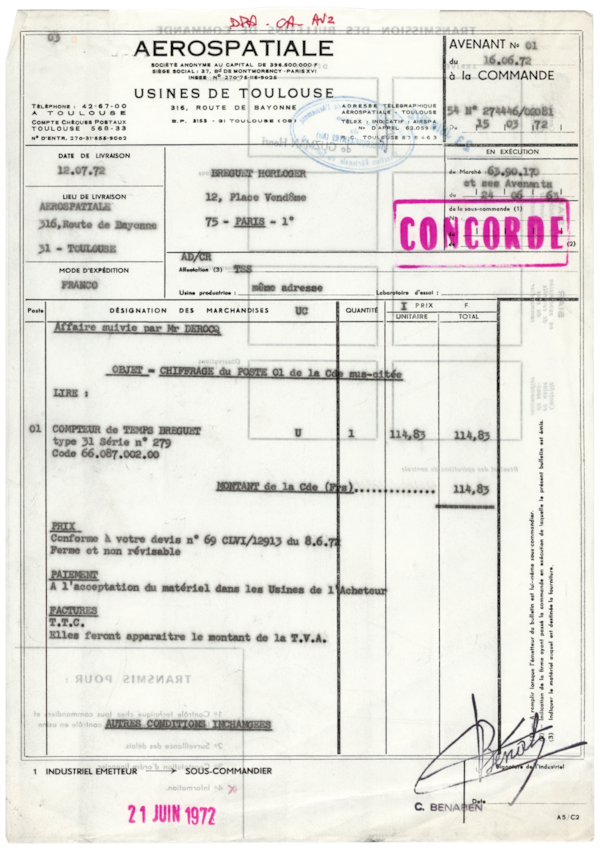
Up:
To equip the famous Concorde supersonic aircraft with an onboard chronograph, Aérospatiale turned to the House of Breguet.
New product and “special function”
At Breguet, the late 1940s saw the emergence of new products reflecting a determination to meet new requirements, and even to anticipate the needs of civil and military aviation, which was then undergoing rapid development. It should not be forgotten that the jet age was beginning worldwide. Time was so precious on board that, for safety reasons, redundancy had to be introduced. The chronograph fitted to the instrument panel was therefore complemented by another chronograph – and not just any chronograph – worn on the pilot’s wrist. If one became unusable, the other took over. This was the entire purpose of the watchmaking instruments whose development we will now follow.
At the beginning of 1949, the Flight Test Centre (CEV), which came under the authority of the French Air Ministry, acquired its first wristwatches. The first, a unique model bearing the number 460, was sold on January 14: Wristwatch with 14-ligne Lemania movement, round waterproof stainless-steel case with lugs, two-pusher chronograph, black tachymeter dial, luminous hour markers and hands… Model completed in November 1948. The other, from a series of five and bearing the number 456, was sold on March 8: Round 13-ligne stainless-steel wristwatch, two-pusher chronograph counter, black dial, luminous hour markers… Model completed in November 1948. Other similar models were probably acquired privately by CEV pilots, notably numbers 457 and 458; they were subsequently returned for repair on behalf of the “Brétigny-sur-Orge Flight Test Centre” and were even exchanged six years later for Type XX watches.
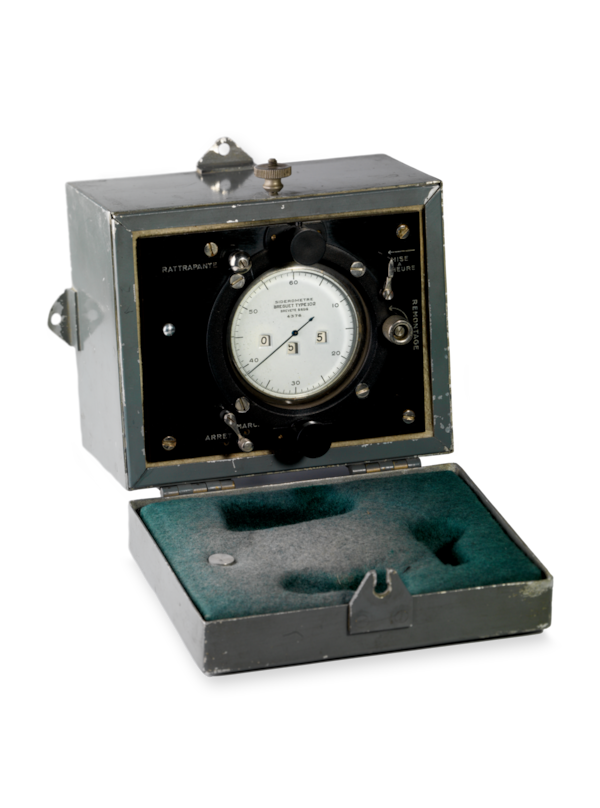
Up:
Breguet onboard chronograph No. 4376, known as the “siderometer”. Produced from 1935 in a series of around forty pieces, the “siderometer” equipped the French Air Force and Air France.
Further investigation reveals two other small series of six chronographs that are particularly noteworthy for the terms used to describe a newly introduced function: 14-ligne wristwatch – special chronograph – rotating bezel with marker – two pushers – reset to zero and immediate restart of the chronograph with a single press – black dial with railway-track hour markers and luminous hands – round stainless-steel case with lugs – leather strap, steel buckle. Available in July 1949, the six chronographs in the first series bear the numbers 409 to 414 and are all sold between September 1949 and May 1950.
Those in the second series, bearing the numbers 832 to 837, are described in slightly greater detail: 14-ligne wristwatch – two-pusher chronograph with special function (direct reset to zero using the second pusher and immediate restart). 30-minute counter, chronograph seconds hand, black dial – railway-track hour markers and luminous hands – round stainless-steel case with lugs, rotating bezel. Leather strap, steel buckle. Produced between October 1950 and November 1951, they are sold between November 1950 and July 1952.
There is still no mention, however, of the official aeronautical services. The special function – extensively highlighted and explained – is not yet referred to as “flyback”, and the term Type XX or Type 20 is not yet used. Moreover, a series of twelve steel chronographs, numbered from 983 to 994, is produced in the meantime, in March 1950, with 30-minute and 12-hour counters, but with a silver dial and without the special function, which is not featured on the 13-ligne Lemania movement then used to equip them. The pieces are sold between July 1951 and October 1952.
Up:
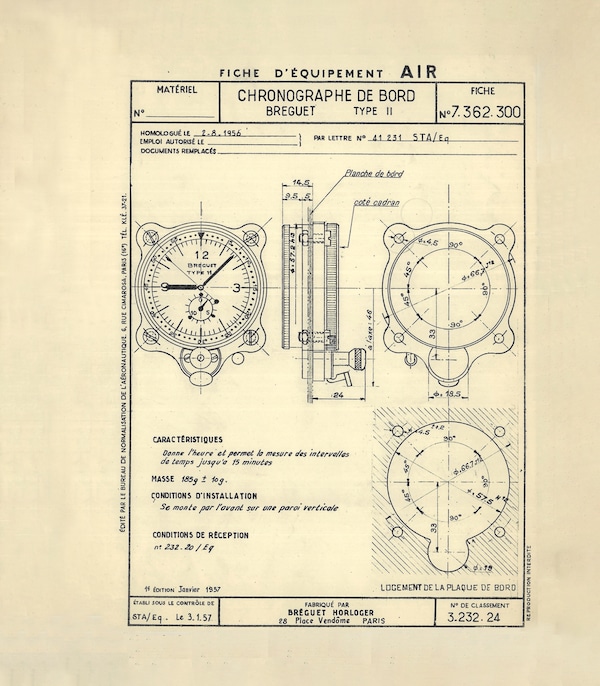
Equipment data sheet for the Type 11 onboard chronograph

The product finds its name
Things began to take shape when three pieces bearing the numbers 1200, 1201 and 1202, succinctly designated – owing to confidentiality – 14-ligne chronograph wristwatch – special – prototype, and completed on June 30, 1952, were delivered on July 23, 1952 to the Aeronautical Technical Service (STAé). The House was aware of the military air forces’ plans for watchmaking equipment and decided to enter the selection trials, with much at stake.
In December 1952, the House once again offered a series of twenty-four steel pieces, equipped with a 14-ligne movement, a 30-minute counter and the special function. They bore the numbers 1163 to 1168 and 1171 to 1176, as well as 1400 to 1402 and 1407 to 1412. Most were sold between December 1952 and May 1954, including four to the Louis Breguet aviation company. Number 1408 was distinguished by its gold case and silver dial featuring a tachymeter scale. Every opportunity was taken to conduct trials of all kinds.
It was not until the spring of 1953 that the designation destined to become so famous first appeared in the House registers, with numbers 1530, 1531 and 1532: Type 20 wristwatch – 14-ligne – two-pusher chronograph with special reset-to-zero and restart function operated by a single press – 30-minute counter, chronograph seconds hand, black dial, luminous hour markers and hands. Waterproof stainless-steel case – rotating bezel, leather strap. Completed on April 27, 1953, they were sold respectively in July, September and October of the same year.
Three other Type 20 watches soon followed with an identical description: first, number 1203, at the very end of 1953. Completed on December 12, the piece was sold on December 15, and the client was none other than a famous aeronautical company already mentioned and closely associated with the House: the Louis Breguet aviation company. The watch was in fact presented by Louis Breguet to the renowned aviator Jacqueline Auriol, a test pilot and leading international figure in post-war women’s aviation.
A few weeks later, the same occurred again… Numbers 498 and 499 appeared in turn in the House’s sales registers, with no further explanation beyond a brief designation:
498: 14-ligne chronograph wristwatch – Type 20 – steel case with gold bezel
499: 14-ligne chronograph wristwatch – Type XX – steel case with gold bezel
The two pieces, whose production dates are unknown, were sold on January 25, 1954, also to the Louis Breguet aviation company. The two designations used, Type XX and Type 20, are noteworthy, although there is no way of determining what might have distinguished the two pieces and thus justified the use of different characters. In any event, both featured an astonishing particularity: a gold bezel on a steel case, an oddity that would never be seen again.
Up:
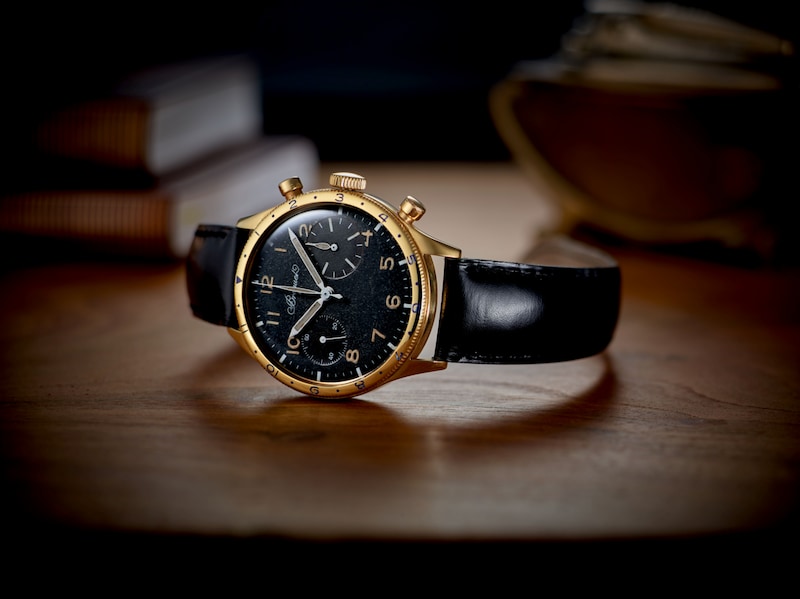
Breguet Type XX chronograph No. 1780, produced in 1955, one of only three first-generation examples made in gold.
Right:
Breguet Type XX chronograph No. 1780, produced in 1955, one of only three first-generation examples made in gold.
Up:
Breguet Type XX chronograph No. 1780, produced in 1955, one of only three first-generation examples made in gold.
These two pieces were the first in a series of 27 “early” Type XX chronographs, numbered from 498 to 524. Of these, only three were referred to as “Type 20”, including number 519, sold to H.M. Bao Dai, Emperor of Vietnam. Three pieces, numbers 502, 512 and 515, were delivered to the Brétigny Flight Test Centre, in exchange for numbers 456, 457 and 458 mentioned above. All were sold between February and August 1954. Thus began a long adventure… Indeed, a new series of twenty-three “Type 20” pieces soon followed in June and July 1954; all were sold almost immediately. The model was a success.
At the end of 1954 and the beginning of 1955, small series of 14-ligne wristwatches followed one another, ten or fifteen pieces at a time, sometimes referred to as Type XX and sometimes as Type 20. According to the descriptions, corroborated by the repair ledgers, all these pieces featured a 30-minute counter.
From time to time, a few pieces equipped with the special function were recorded, although they were not Type XX watches, as they featured a silvered dial, gold hands and a 12-hour totaliser in addition to the 30-minute counter. Numbers 1735 to 1737, produced in December 1954, are examples of this.
In February and March 1955, however, two pieces appeared, numbers 1781 and 1780, with a gold case, satin-finished silver dial, gold hands and a tachymeter scale; the first was a Type 20 and the second a Type XX. This brought the number of gold pieces to three; no others would be produced.
Type XX or not Type XX, Type XX in Roman numerals or Type 20 in Arabic numerals: all this was somewhat confusing, but fortunately not for much longer. By mid-1955, things finally seemed to fall into place. Apart from the pieces soon to be delivered to the French Air Force, all of which would remain “Type 20” watches, numbered with special numbers beginning with 7 or 8 and recorded in a dedicated ledger, all the others, regardless of their developments and variations, were henceforth definitively referred to as “Type XX”. With one exception, however: a small series of eight pieces produced in September 1957, with 15-minute and 12-hour counters, which still bore the designation “Type 20”…
Within the inner workings of the Air Ministry…
On the military side, matters had been progressing since the beginning of 1952. Found in the archives of the Ministry of Defence and sent by the STAé (Aeronautical Technical Service) to the director of the Besançon National Observatory, a letter dated April 29, 1952 confirms that the House of Breguet was interested in the matter of onboard and wrist chronographs. Quite logically, a few weeks later – on July 23 – the House delivered to the STAé the three prototype pieces, numbers 1200, 1201 and 1202, mentioned above.
As we have seen, the designation Type 20 appears in the ledgers to refer specifically to pieces completed in April 1953; this means that the “code name” Type 20 had been chosen by the official services in the preceding weeks or months. It was indeed in the spring of 1953 that the major step of obtaining official STAé approval took place. Another document entitled Progress Report, classified Secret Défense and dated July 1, 1953, reveals that by that date the BREGUET Type 20 wrist chronograph – a chronograph equivalent to the German Hanhart chronograph – had already been approved.
The specifications
Much has been said about specifications applying to the Type 20, and searches have been made in vain for a Type 20 equivalent of the well-known Type 21 specifications, an official document published in April 1956 by the Aeronautical Technical Service in the form of a nine-page booklet. Entitled Technical programme for Type 21 chronograph wristwatches intended for use in flight, the text reviewed the stringent technical, aesthetic and functional requirements imposed on the pieces, as well as the numerous tests they had to pass successfully: a case approximately 37 mm in diameter with a screw-down back, resistant to dust and moisture; a shock-protection device and a system preventing the balance spring from catching; a 35-hour power reserve; a rotating bezel with a luminescent marker; large luminescent numerals and a peripheral scale with 300 divisions; small seconds at 9 o’clock and a 30-minute counter at 3 o’clock; a daily rate variation of no more than 15 seconds; operation under acceleration of at least 5g; operation within a magnetic field of 12 gauss, etc.; tests in an overpressure atmosphere followed by an underpressure atmosphere, etc. However, Chapter 1 stated: The conditions set out in this programme are not mandatory, but will serve as a basis for drafting the regulations relating to this type of instrument. In this context, it is difficult to determine which tests were imposed on the pieces and the level of stringency required by the authorities…
It must be acknowledged that, apart from the shock-protection device recommended for the Type 21, the Type 20 appears broadly to comply with this 1956 document. As suggested by the previously cited 1953 document, the STAé had defined an instrument called Type 20, inspired at least in part by a German Hanhart chronograph, a certain number of which had been received by the French armed forces as “spoils of war”, but without drawing up official specifications. Those familiar with the French administration would say that, had an official document concerning the Type 20 been drafted in 1952 or 1953, the April 1956 document relating to the Type 21 would necessarily have begun with wording such as: This document cancels and replaces the previous document relating to Type 20 wristwatches dated… etc. To conclude on this point, it should be added that although the House archives contain records of seven pieces designated Type 21 and completed in September 1956, three of which, equipped with a 30-minute counter, were delivered to the STAé on October 8, 1956, it must be acknowledged that this had no impact on the orders already in progress or on the subsequent developments of the House of Breguet, which continued to produce only Type 20 or Type XX watches… In other words, certain Houses, including Breguet and a few others, produced Type 20 watches, while others manufactured Type 21 watches. Could one go so far as to say that, apart from a few minor differences, the same product had two names?
Up:
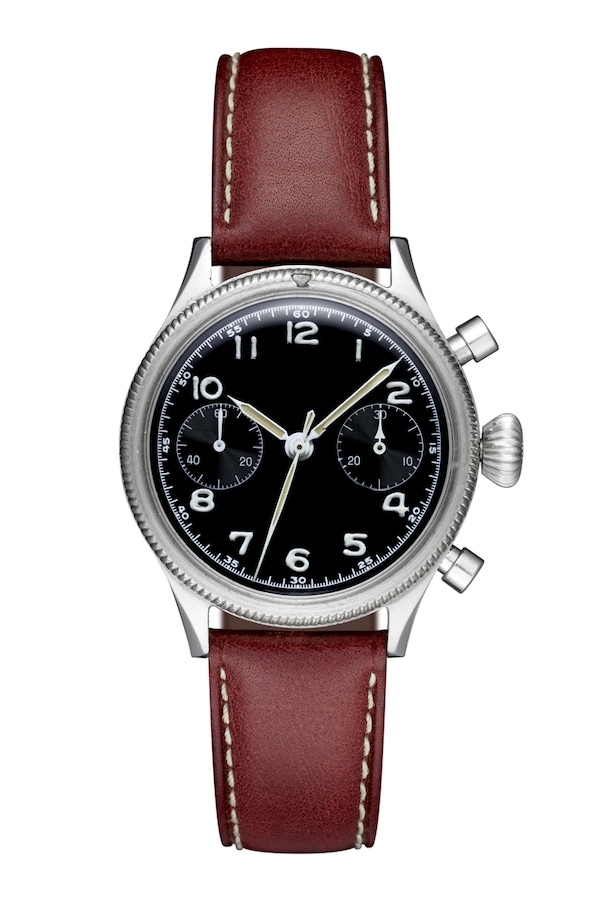
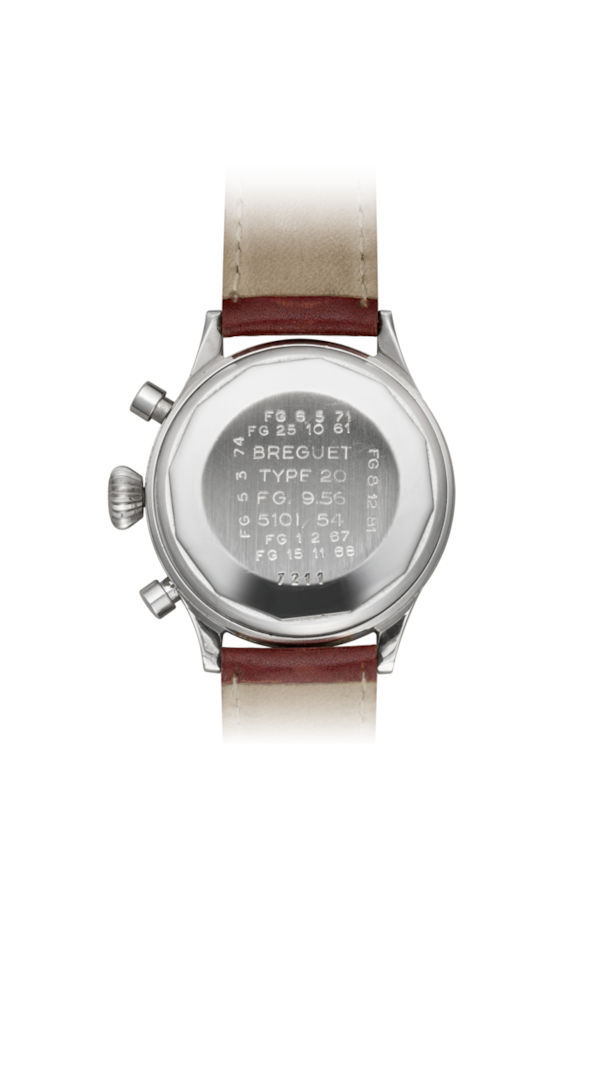
Breguet chronograph No. 7211, a “military Type 20”, delivered to the French Air Ministry on November 16, 1955. Its dial is unsigned, and the markings on the caseback can be seen.
The large 1954 order
Following the approval obtained in 1953, all that remained was the administrative process of awarding the contract. A matter of a few months. It was in 1954, under contract number 5101/54, that the House of Breguet was awarded what appeared, on its scale, to be the “contract of the century”. The total order placed with the House of Breguet by the Air Ministry for the needs of the French Air Force amounted to… 1,100 pieces!
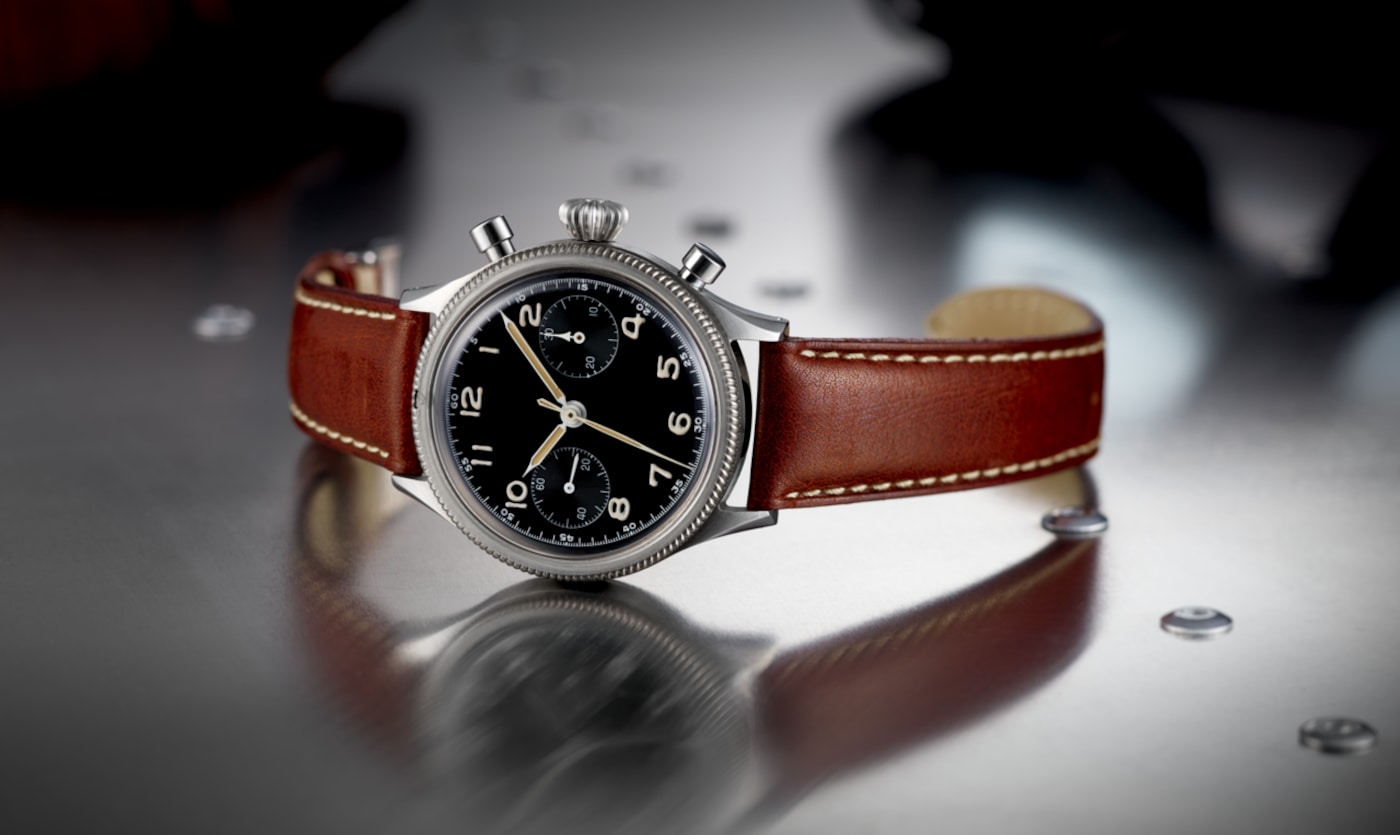
From November 1954 onwards, a first batch of 250 pieces was delivered on June 17, 1955, followed by a second batch of 240 pieces on November 16 of the same year. Two further equivalent batches quickly followed: 245 pieces on June 1, 1956, and 245 pieces on July 31, 1957. In two years, 980 pieces were delivered. The remaining 120 Type 20 watches were delivered in 1958 and 1959. These Type 20 watches supplied to the Air Ministry can be recognised at a glance: a small-diameter 30-minute counter, unsigned dial, ungraduated bezel, regulation markings on the caseback and a pear-shaped winding crown. In addition to its aesthetic appeal, the latter was genuinely easy to use, as it could be handled even with a gloved hand.
Up:
Known as Type 20, the pieces intended for the French Air Force were distinguished notably by their one-fifth-of-a-second graduations.
Right:
Known as Type 20, the pieces intended for the French Air Force were distinguished notably by their one-fifth-of-a-second graduations.
Up:
Known as Type 20, the pieces intended for the French Air Force were distinguished notably by their one-fifth-of-a-second graduations.
One movement: the VALJOUX 22 and its derivatives
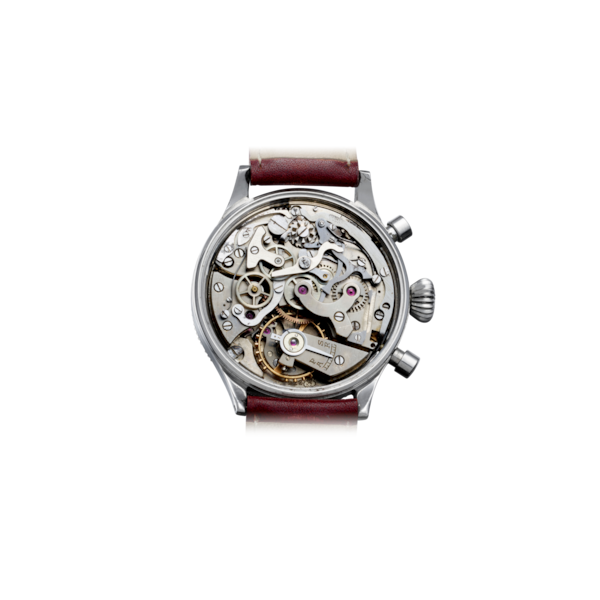
To equip its Type XX watches, Breguet selected the Valjoux 22. This 14-ligne movement, measuring 32.6 mm in diameter, was ordered by Breguet with a refined finish, described as AA in certain records, and fitted with the additional module known as the “flyback”. At the time, this function was often referred to in the Breguet archives as the “special function”, or in Valjoux documentation as the “night mechanism” or “direct reset mechanism”, the important thing being that everyone understood what it meant.
A hand-wound movement with a power reserve of approximately 35 hours and fitted with a column wheel, the Valjoux 22 entered Breguet’s history in two variants: calibre 222 for pieces equipped with a 15- or 30-minute counter, and calibre 225 for pieces featuring an additional 12-hour totaliser. It beat at 18,000 vibrations per hour and featured a screw balance and a Breguet overcoil. Despite the absence of an Incabloc-type shock-protection system, it was renowned for its robustness and proved entirely satisfactory. The 222–225 duo equipped Breguet Type XX watches until 1963.
At the end of 1963, with the piece bearing No. 2087, the first “13-ligne Type XX” appeared, equipped with Valjoux’s new modernised calibre. This 13-ligne movement, measuring 29.50 mm in diameter, was definitively adopted by Breguet in the following two variants: the Valjoux 230 calibre, which would equip all “two-counter” Type XX watches, and the Valjoux 720 calibre, which would equip the “three-counter” Type XX watches. Designed in the same spirit as their predecessors, these modernised calibres featured an Incabloc system and a plain balance. This change of movement had no impact on the external appearance of the Type XX. The cases remained unchanged, with a casing ring compensating for the movement’s reduced diameter.
The 12-hour totaliser and the CEV order
While the Type 20 watches for the French Air Force were under construction, Breguet set about developing a whole series of variants for its “civilian” clientele and other organisations. In May 1955, a piece bearing the number 1888 appeared, fitted with an additional small subdial positioned at 6 o’clock; this displayed a 12-hour totaliser. This piece was followed in June by a small series of 25 pieces, all equipped with a 12-hour totaliser. The Type XX family was expanding and beginning to reach cruising speed…
This Type XX, often referred to for simplicity as the “three-counter” model, particularly appealed to a client already mentioned and which it is now time to discuss in detail. The Flight Test Centre (CEV) was an organisation that operated from 1945 to 2001 at Brétigny-sur-Orge, 25 km south of Paris. Its extensive missions included testing military aircraft prototypes and their equipment, including parachutes, ejection seats, radio-navigation equipment, onboard radar and weaponry. In the 1950s, the CEV employed around fifty pilots, approximately twenty of whom held special test-pilot qualifications. They represented the elite of French aviation. As already noted, the CEV and/or members of its staff had acquired their first Breguet chronographs – without the flyback function – in 1949, four pieces in total, and three of these pieces had been exchanged by the House of Breguet for three Type XX watches on February 15, 1954. Was the CEV tasked with conducting official tests on Breguet products? This is possible, if not probable. In any event, from the end of 1956 onwards, the Type XX would become the operational watch of this prestigious organisation.
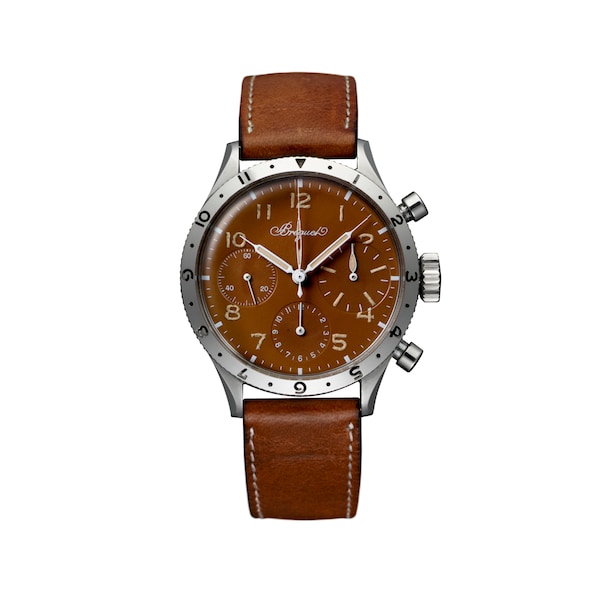
No fewer than 80 additional “14-ligne Type XX” watches were added to the pieces already mentioned: 17 pieces delivered on December 12, 1956, and 33 pieces delivered on March 5, 1957. These 50 pieces, described as featuring 15-minute and 12-hour counters, were joined by a further 30 pieces delivered on May 2, 1957, the latter equipped only with a 15-minute counter. All bore the inscription “CEV” on the caseback, followed by a number ranging from 1 to 80. The so-called “three-counter” pieces were numbered from 1 to 50, while the so-called “two-counter” pieces were assigned numbers from 51 to 80. The piece bearing the number 2499 and the inscription CEV 1 logically went to the head of the CEV, Engineer General Louis Bonte, and its brown or “chocolate” dial is particularly noteworthy; it is now part of the Breguet Museum collections.
Up:
Breguet Type XX chronograph No. 2499. Marked CEV 1 on the caseback, this example was used by the Centre’s director.
1958: the Navy in turn seeks to equip its pilots…
In 1958, another major order was placed, this time by the other branch of French military aviation, known as Naval Aviation and attached not to the Air Force, but to the French Navy. Although smaller than the Air Force order, it was far from negligible, amounting to 500 pieces. These pieces differed significantly from the previous ones. In the ledgers, they appear consecutively under the individual numbers 3927 to 4427. To this number was added the number within the series of 500, which was not sequential, but random.
Perhaps enough to discourage potential counterfeiters…
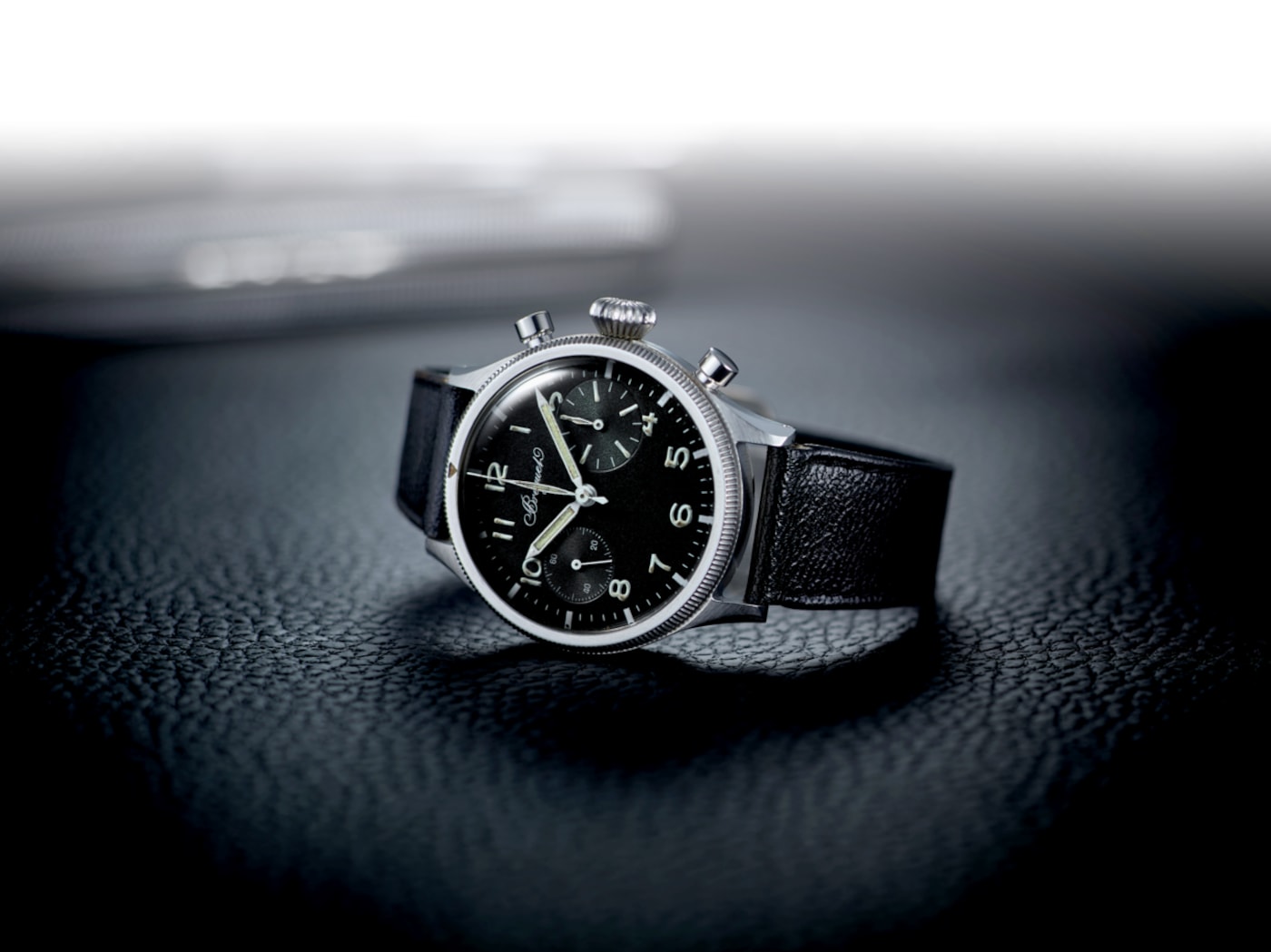
Opposite number 3927 appears a description providing more detail than usual: 14-ligne Type XX chronograph wristwatch, waterproof steel case, rotating bezel with luminous marker, 15-minute totaliser, black dial, luminous hour markers and hands, luminous 5-minute divisions and five luminous markers on the totaliser. Assembled between October 1958 and December 1959, the 500 pieces ordered by the French Navy for Naval Aviation were all delivered on the same day, January 13, 1960. Like their “cousins” delivered to the Air Force, they are easily identifiable, but are far from identical: large-diameter 15-minute counter, signed dial, ungraduated bezel, regulation markings on the caseback and pear-shaped winding crown.
Up:
The Type XX watches of French Naval Aviation feature a signed dial and an enlarged 15-minute counter.
Right:
The Type XX watches of French Naval Aviation feature a signed dial and an enlarged 15-minute counter.
Up:
The Type XX watches of French Naval Aviation feature a signed dial and an enlarged 15-minute counter.
The many lives of a benchmark timepiece
Becoming, within just a few years, the benchmark brand and the supplier to three clients as prestigious as the French Air Force, the Flight Test Centre and French Naval Aviation was a notable achievement for the House of Breguet, which nevertheless did not rest on its laurels. Indeed, these approximately 1,700 pieces represented barely half of the total production, around 4,000 units, manufactured up to 1970. Available throughout this period, the Type XX became the “iconic” timepiece of the entire aeronautical world and even beyond, as we shall see.
Visually, the piece had found its definitive form: that received by the Flight Test Centre, namely a 15-minute and 12-hour counter, or a 15-minute counter only (the 30-minute counter was no longer offered after 1958, with six exceptions), and a graduated rotating bezel. This did not, however, rule out developments in the movement, rare dial variations, or hands whose shape occasionally changed on small series.
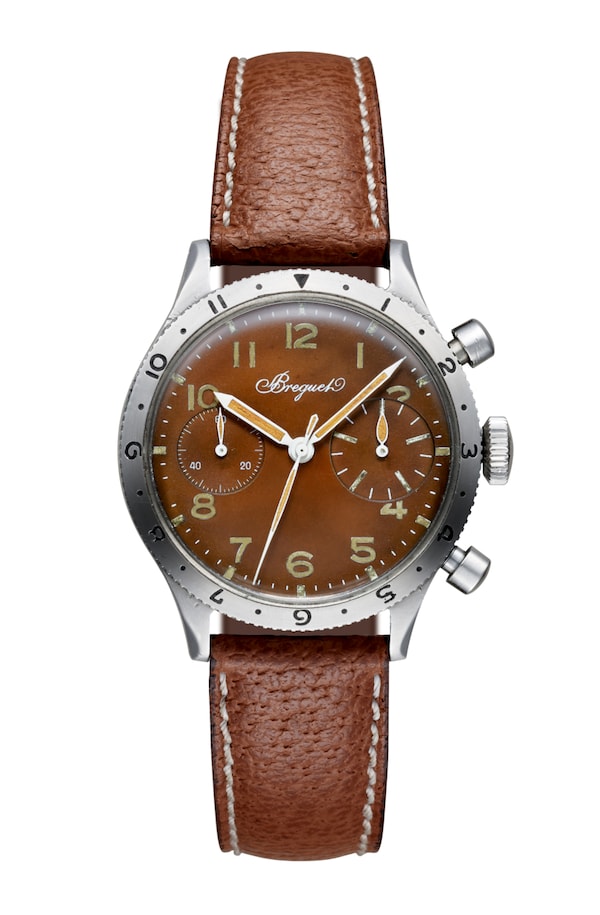
A very small number of pieces, no more than a few dozen, were originally fitted with a brown dial; over time and through exposure to sunlight or moonlight, the dials of other pieces acquired a slightly brownish hue…
For enthusiasts of high precision, certain pieces were offered with the coveted Rating Certificate issued by the Besançon Observatory, confirming that they met the standards of the world’s most accurate watches. A total of twenty Type XX watches were thus marketed “with Rating Certificate” at a price nearly 25% higher. They were completed in November 1957 (3), July 1958 (10) and October 1959 (7). Nine featured a 30-minute counter, two a 15-minute counter, and nine featured both 15-minute and 12-hour counters.
Extremely rare pieces, only two according to the sales ledgers, were fitted with a rotating bezel featuring a tachymeter scale, although the House occasionally supplied such bezels upon request. Similarly, the standard dial was sometimes replaced in the Breguet workshops with one featuring a tachymeter scale, but this remained highly exceptional.
The reputation of the Type XX was a reality from which the House of Breguet benefited fully. Alongside the many pilots, chronograph enthusiasts and loyal clients of the House were organisations connected with civil or military aviation, such as the ENAC (French National Civil Aviation School) and the French National Gendarmerie, probably for its helicopter pilots, as well as foreign airlines such as Air Gabon and Véha Akat of Laos…
Beyond the world of aviation, the watch of engineers and racing drivers…
Yet the appeal of the Type XX extended beyond the various aeronautical circles and attracted certain sectors of research and industry, which sought to provide their engineers and technicians with a watch suited to their missions. This category included purchases by the CNET (French National Centre for Telecommunications Studies) – 22 pieces between 1956 and 1968 –, the Énergie Atomique company – 6 pieces in 1959 –, as well as Électronique Marcel Dassault in 1963, French Television in 1957 and the Aeronomy Service, the first French scientific research laboratory in space, in 1966.
The versatility of the Type XX did not end there, as the archives reveal that two companies well known to the general public, the oil companies Shell and Esso, also acquired Type XX chronographs: 10 pieces for Shell, sometimes referred to as “Shell Berre”, between 1954 and 1965, and 35 pieces for Esso, then known as “Esso Standard”, between 1955 and 1963.
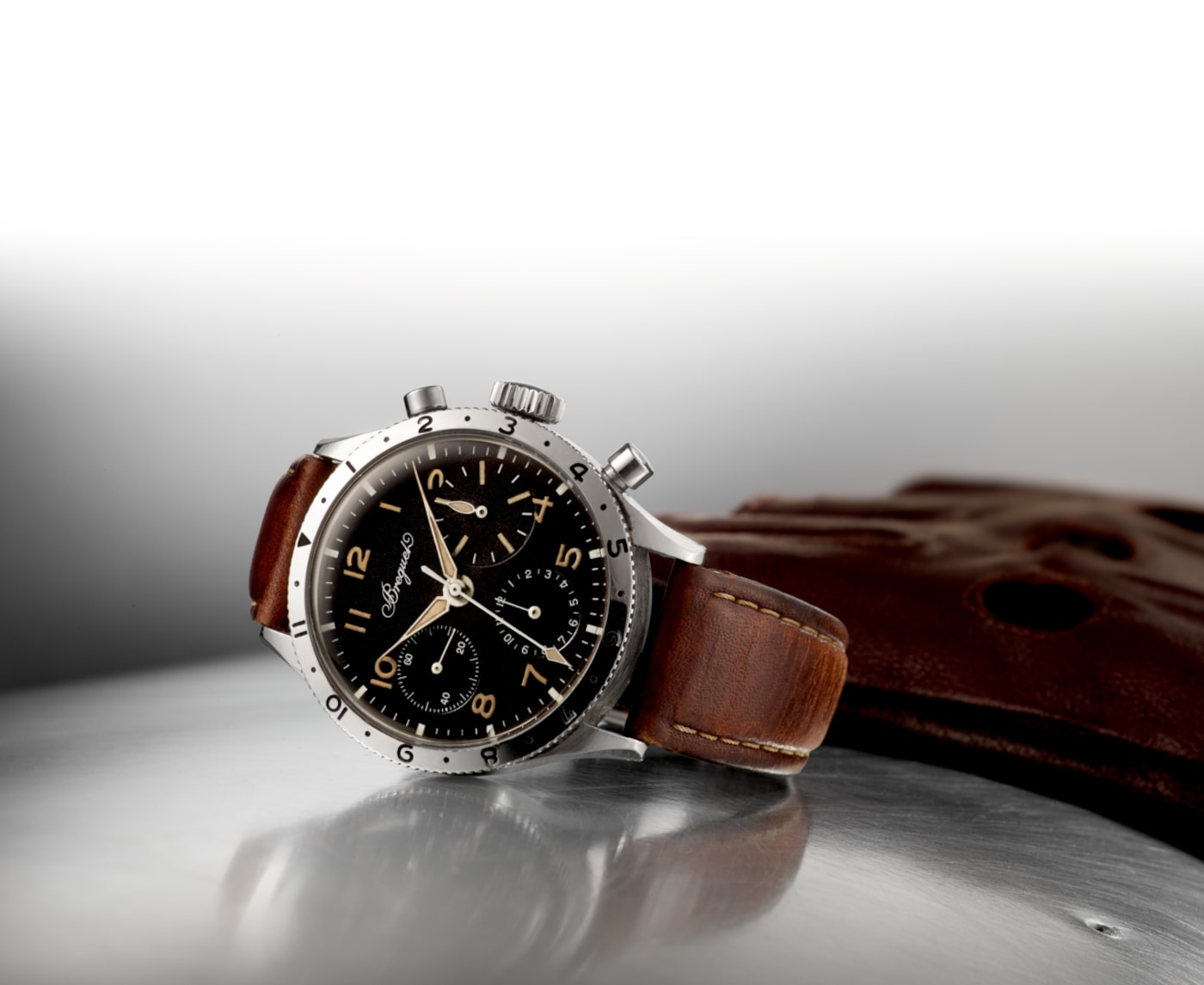
As organisers or partners of numerous motor races, these companies presented these watches to the winners of major competitions. Thus, in 1959, a Type XX was awarded to each of the three winners of the 28th Monte Carlo Rally, who competed in a Citroën ID: Messrs Alexandre, Coltelloni and Desrosiers. Type XX No. 3065, the example belonging to Mr Pierre Alexandre, is now part of the Breguet Museum collections. It had been sold to Esso Standard on November 21, 1957. Another Type XX, sold to Esso Standard on February 4, 1959, was presented to the great French rally driver Fernand Masoero. Type XX No. 4962, also sold to Esso Standard on May 5, 1960, was presented to Jack Brabham, who had won the Formula 1 World Championship title a few months earlier.
Thus lived the Type XX, an aviation watch that appealed to all and formed a remarkable chapter in the already rich history of the House. Despite a technical development introduced in 1963, with the replacement of the 14-ligne Valjoux movement by a modernised 13-ligne Valjoux version, the appearance of the Type XX remained unchanged for fifteen years. Could this continue?
It was not until 1970 that the model underwent a significant aesthetic evolution. This marked the arrival of the second-generation Type XX, launched in 1971…
Up:
Breguet Type XX chronograph No. 3065, sold to Esso Standard in November 1957.
Right:
Breguet Type XX chronograph No. 3065, sold to Esso Standard in November 1957.
Up:
Breguet Type XX chronograph No. 3065, sold to Esso Standard in November 1957.