Breguet Watch Complications
Since 1775, Breguet has designed mechanisms that go beyond the simple indication of hours and minutes. A complication can measure short intervals of time, follow astronomical cycles, indicate several time zones, strike the hour or improve the regularity of a movement.
Precision and regulation
The Tourbillon
Invented by Abraham-Louis Breguet and patented in 1801, the tourbillon was born from a quest for precision. By placing the escapement and the balance wheel in a mobile cage, it makes it possible to distribute the effects of gravity on the regulating organ. More than two centuries after its invention, it remains one of the most emblematic signatures of Breguet.
Time measurement
Chronograph and flyback
The chronograph makes it possible to measure an interval of time without interrupting the display of the time. A technical function par excellence, it finds a particularly strong expression at Breguet in the world of Type XX. The flyback function makes it possible to stop, reset and restart the chronograph with a single press. A function designed to link several successive measurements in quick succession.
Astronomical functions
Moon phase, equation of time, perpetual calendar
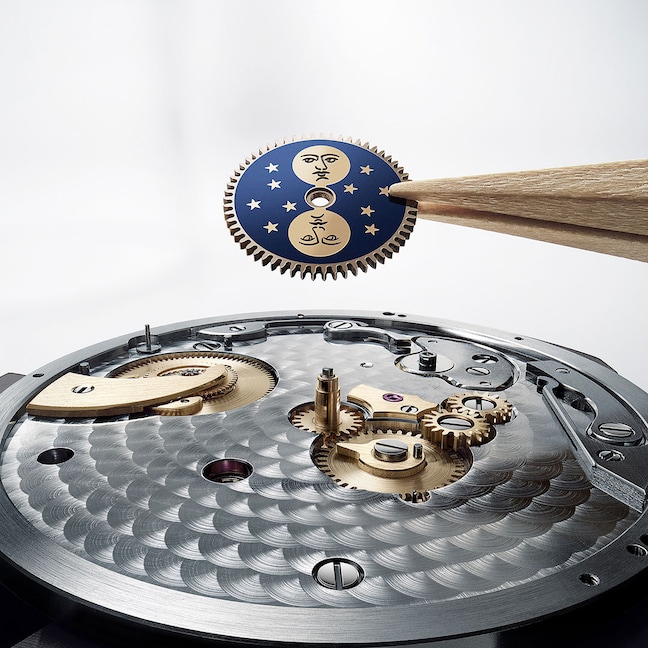
Some complications do not only measure time: they express the cycles of the sky and the calendar. Moon phase, equation of time and perpetual calendar connect watchmaking mechanics with astronomical movements. At Breguet, these functions combine mechanical precision, dial legibility and a sense of composition.
Travel time functions
Second time zone and day/night indication
Travel-related complications answer a simple question: how can several times be read at once, without losing clarity or ease of use? The second time zone with memory makes it possible to switch instantly from one place to another, while the day/night indication makes 24-hour time easier to read.
Striking complications
Minute repeater
The minute repeater makes time audible. On demand, it strikes the hours, quarters and minutes by means of a mechanism of hammers and gongs. This complication requires mechanical mastery, but also acoustic mastery: each element of the case and the movement contributes to the clarity, duration and quality of the sound.
Whether related to precision, the calendar, travel, time measurement or sound, Breguet complications express one and the same requirement: giving mechanical form to a precise function. Each complication extends a vision of watchmaking in which use, technique and movement architecture advance together.