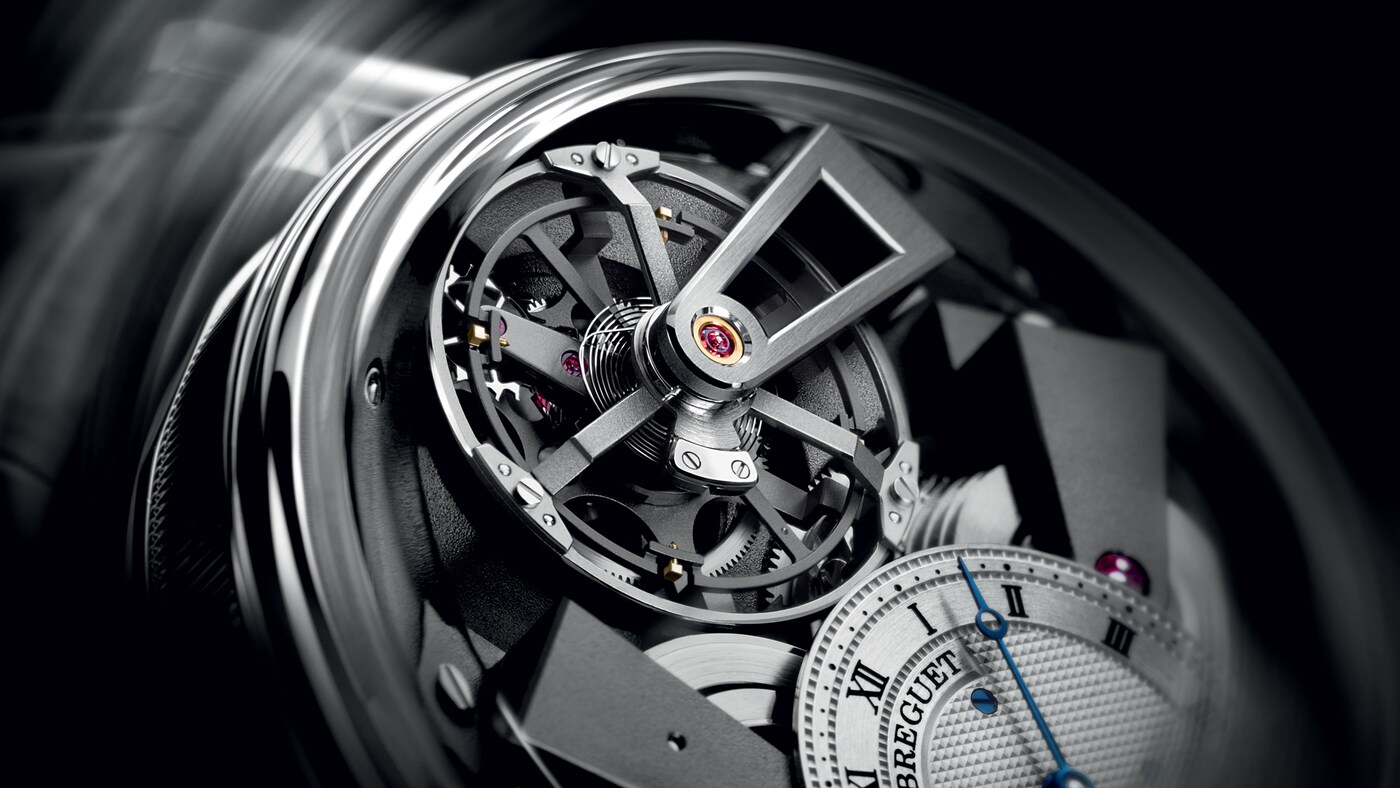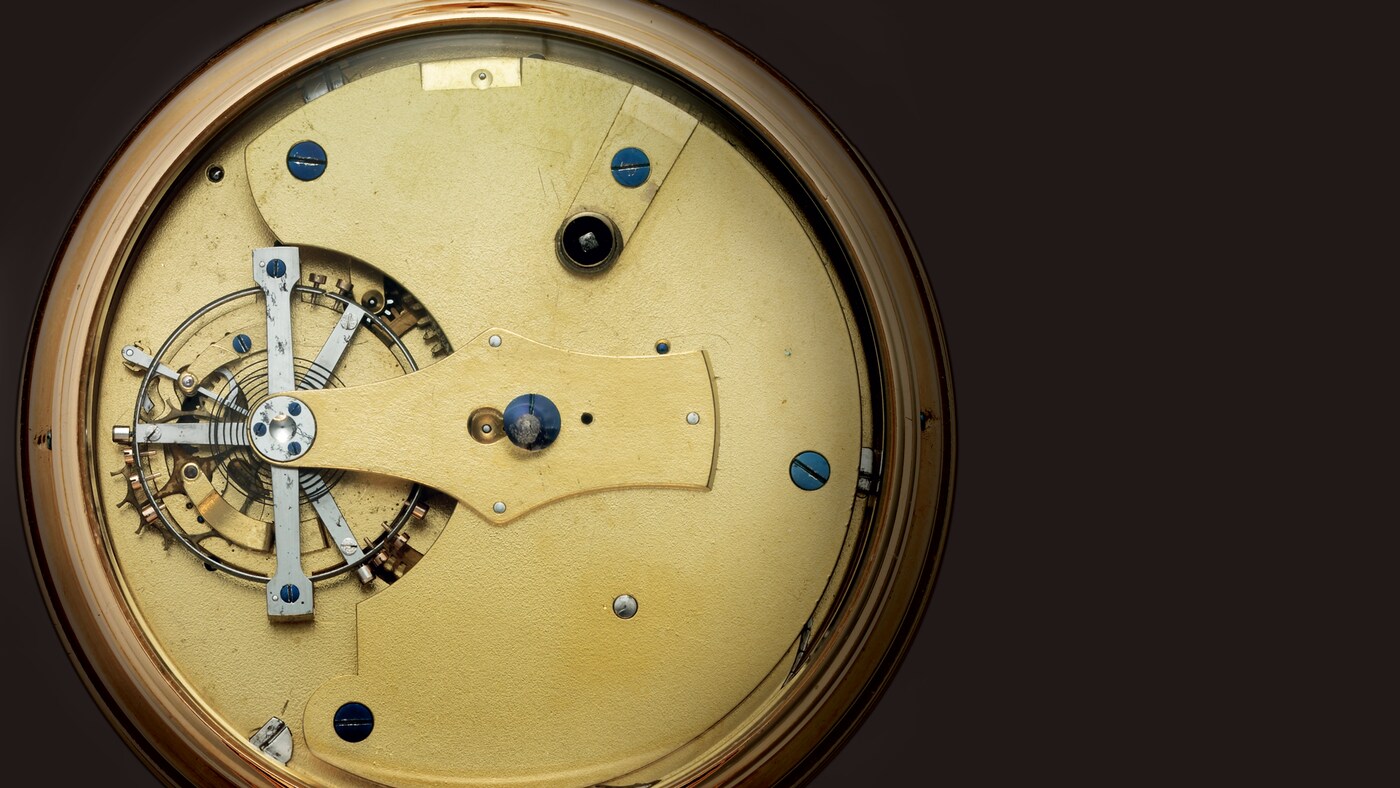

ON THE BIRTH OF THE TOURBILLON
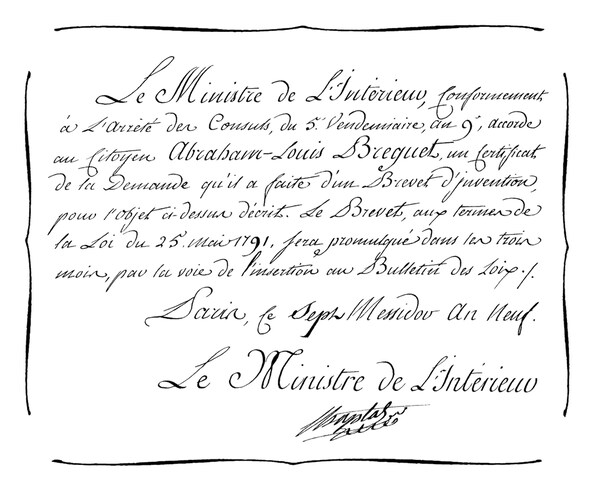
by Emmanuel BreguetOn June 26, 1801, or more precisely 7 Messidor Year IX, as the Republican calendar was then in force in France, Abraham-Louis Breguet obtained from the competent authorities a ten-year patent for a new type of regulator known as the “tourbillon”. A few months earlier, on December 24, 1800 (3 Nivôse Year IX), the watchmaker had submitted the complete technical file together with its watercolour plate, the result of extensive studies and meticulous experimentation.

This was the second time Breguet had applied for and obtained a patent. Three years earlier, on March 9, 1798 (19 Ventôse Year VI), he had patented “a constant-force escapement” applicable to both watches and clocks. There would be no third occasion, as Breguet did not consider it useful to apply for further patents after the tourbillon. Did he find the procedure too cumbersome, or simply unnecessary in his case? The question could be debated at length.
The French patent for invention, established by the law of January 7, 1791, was – and still is – a property right granting its holder a temporary monopoly on the industrial and commercial exploitation of an invention, as well as legal protection, particularly against counterfeiting, in exchange for its publication.
The “tourbillon” file preserved in Paris in the archives of the Institut National de la Propriété Industrielle (INPI) contains the accompanying letter addressed to the Minister of the Interior, under whose authority the patent office operated. In these few lines, Breguet sought to summarize his thinking and to make an original, new and complex process understandable to readers unfamiliar with the intricacies of watchmaking. This letter, typical of Breguet’s epistolary style, deserves to be quoted in full:
Breguet, to the Minister of the Interior.
Citizen Minister,
I have the honour of presenting to you a memorandum containing the description of a new invention applicable to machines for measuring time, which I call the Tourbillon Regulator, together with a request for the privilege of constructing these Regulators for a period of ten years.
By means of this invention, I have succeeded in compensating for and cancelling out the anomalies caused by the different positions of the centres of gravity of the Regulator’s movement; in distributing friction over all parts of the circumference of the pivots of this regulator and of the holes in which these pivots move; in ensuring that the lubrication of the friction surfaces remains constant despite the coagulation of the oils; and, finally, in eliminating many other causes of error which have a greater or lesser influence on the precision of the movement, and which until now the art could only overcome through endless trial and error, often with no certainty of success.
It is in consideration of all these advantages, of the improved manufacturing methods now at my disposal, and of the considerable expenses I have incurred in acquiring these means, that I have decided to apply for a privilege in order to establish the date of my invention and to secure the compensation due for my sacrifices.
Greetings and Respect,
Breguet
Quai de l’Horloge No. 51.
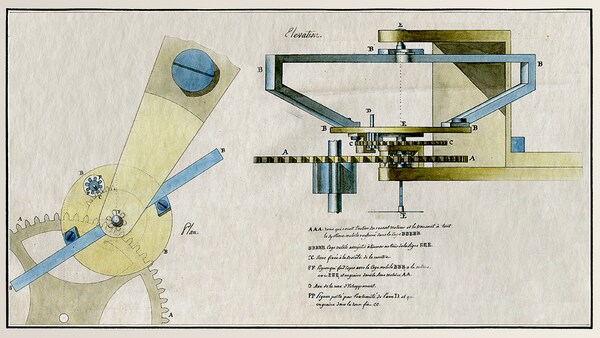
Six months later, the official response from the Minister of the Interior, Jean-Antoine Chaptal, granted Breguet’s request, shortly followed by publication of the decree in the Bulletin des Lois de la République.
Interestingly, the same Chaptal had purchased from Breguet, on November 21, 1800 (30 Brumaire Year IX), a repeating watch bearing No. 621.
With the tourbillon, Breguet created a mechanism that would contribute greatly to his reputation. After a long list of inventions – the perpetual watch, gong spring, pare-chute, and, more recently, the sympathique clock and the montre à tact – he once again demonstrated the extraordinary fertility of his genius.
Once again, as a true pioneer, he created both the word and the object, and words, like inventions, were not chosen by chance. What does the word “tourbillon”, now so famous in watchmaking, so frequently used and perhaps so little understood, actually mean? Why did he consider it the most appropriate term?
The most familiar meanings of the word tourbillon are puzzling: violent rotation, unpredictable and impetuous movement, an uncontrollable storm or, figuratively, agitated behaviour… none of these seems particularly compatible with the calm and regularity of a watch movement. “Trees uprooted by a whirlwind”, “there are some very dangerous whirlpools in this river”, or “the whirlwind of business and pleasures” are examples commonly given by dictionaries.
The analogy with watchmaking must therefore be sought elsewhere. To do so, consulting two monumental reference works – Pierre Larousse’s Grand dictionnaire universel du XIXe siècle and Émile Littré’s Dictionnaire de la langue française – proves illuminating.
Indeed, another meaning of tourbillon is almost forgotten today. It is the one defined by Descartes in his Principles: “The planets revolve around their sun, carried along by their vortex,” according to Larousse. Littré is more explicit, defining it as the “name given by the Cartesians to the revolution of a planet, or a celestial body, around its centre, and to the movement of the surrounding matter that follows it.” A century later, this interpretation was taken up and explained by d’Alembert, again quoted by Littré: “This great philosopher [Descartes], at a time when astronomical observations, mechanics and geometry were still very imperfect, devised, in order to explain the movements of the planets, the ingenious and celebrated hypothesis of vortices.”
At the crossroads of astronomy and philosophy, the word tourbillon thus refers to a planetary system and its rotation around a single axis. Here we find regularity and definition, far removed from the caprices of meteorology, and from this undoubtedly arises the analogy with watchmaking, a science in which eighteenth-century philosophers liked to see a miniature transposition of the cosmos.
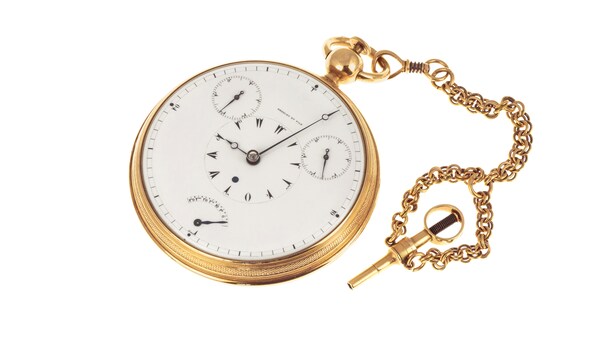
It was indeed this meaning that Breguet, a man of the Enlightenment and a reader of Descartes and the Encyclopédie, was referring to when he chose the term. He drew on knowledge acquired during his years of study under Abbé Marie, a clergyman with a passion for mathematics and astronomy. He had already borrowed vocabulary from philosophy by calling his automatic watches perpetual movements, and from physiology with his “sympathique” clock and his “montres à tact”.
His tourbillon was therefore a new mechanism which, through its constant rotation, cancelled out the effects of terrestrial gravity.
Abraham-Louis Breguet had observed that gravity was the enemy of regularity in watch movements, since it caused variations in rate whenever the position of a watch changed while being worn.
To solve this problem of terrestrial gravity, inherent in all human activity, the master conceived the idea of placing the entire escapement – that is, the balance and balance spring, lever and escape wheel, the components most sensitive to gravity – inside a mobile cage making one complete revolution every minute. In this way, as all errors were reproduced regularly, they would compensate for one another. In addition, the continual change in the point of contact between the balance pivots and their jewels would ensure better lubrication.
Brilliant in principle but extremely complex to execute, the tourbillon was still far from “operational” in the summer of 1801. After two experimental models – watch No. 169, presented to the son of London watchmaker John Arnold in 1809, and watch No. 282, completed in 1800 and sold much later by Breguet’s son – the first tourbillon would not be commercialized until 1805.
The following year, the invention was presented to the public at the Exposition Nationale des Produits de l’Industrie, held in Paris on the Esplanade des Invalides in September and October 1806. Described as a mechanism by means of which timepieces “maintain the same accuracy whatever the position of the watch, whether vertical or inclined”, the tourbillon regulator would henceforth never cease to fascinate.
The greatest watch enthusiasts could not resist its appeal: the famous Italian patron and collector Sommariva; Monseigneur Belmas, Bishop of Cambrai; the Spanish Bourbons, who would own as many as three tourbillons acquired between 1808 and 1814; and the Prince Regent of England, who in 1814 purchased a large tourbillon mounted at the top of a gilt-bronze cone.
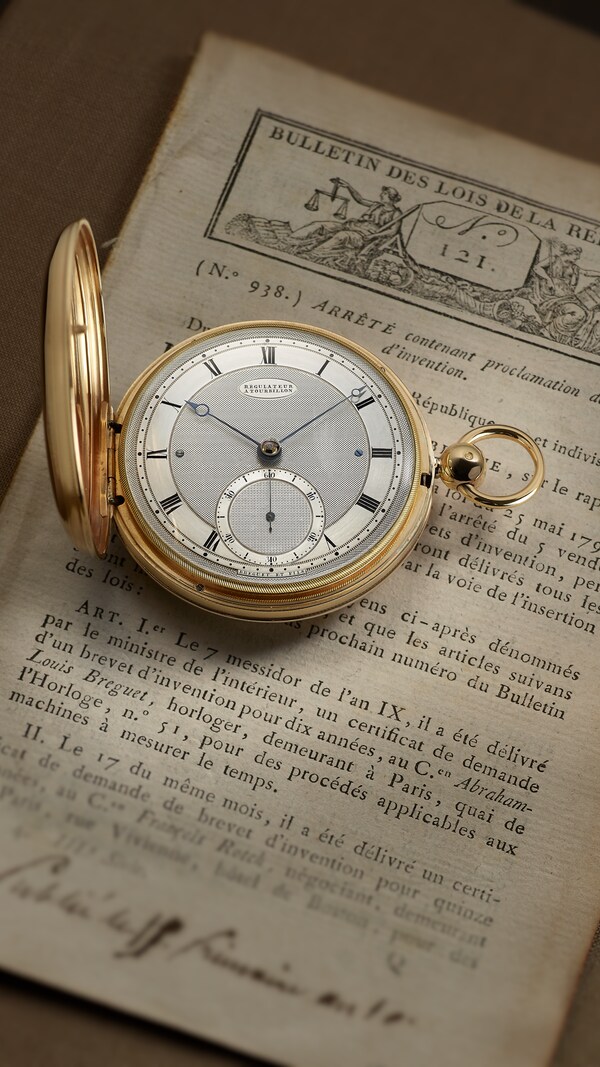
Somewhat mysterious and reserved for connoisseurs, only 35 tourbillons were sold between 1805 and 1823, the year of the master’s death. His successors, however, made it their duty to perpetuate this exceptional expertise to the present day, adding new feats along the way – simple tourbillons or tourbillons equipped with additional complications. No watch enthusiast anywhere in the world can now ignore Breguet’s remarkable invention, which was brought back into fashion in wristwatch form during the 1980s. Not to mention the many manufactures that now produce countless tourbillons.
Even though progress in watchmaking has made it possible to achieve far greater regularity by more conventional means, the tourbillon, patented in 1801, remains a major invention, a legendary achievement in Breguet’s career. Through its subtle links with astronomy and the human sciences, it also belongs historically to a pivotal moment in European thought.