
La Tradition Tourbillon
by Джеффри С. КингстонFive centuries in the making. Take note of the absence of an exclamation point. There is no hyperbole in the statement, simply a flat observation of the half-millennial path of invention that lies behind Breguet’s La Tradition Tourbillon. No fewer than six landmark inventions and four patented designs are tucked within the 41mm case of each Tradition Tourbillon, one invention properly credited to Leonardo da Vinci, the remainder of the inventions and all of the patents to either Abraham-Louis Breguet or modern Breguet. These milestones begin with Leonardo da Vinci’s sketch of a fusée device in 1490, jump to A.-L. Breguet’s inspirational conception of the tourbillon and overcoil, and re-emerge again with the present day Breguet-developed titanium balance, silicium spiral, and a novel method for placement of the power reserve indication on the winding barrel. Details of all of these advances in the art emerge with a tour of the components that bring this timepiece to life.

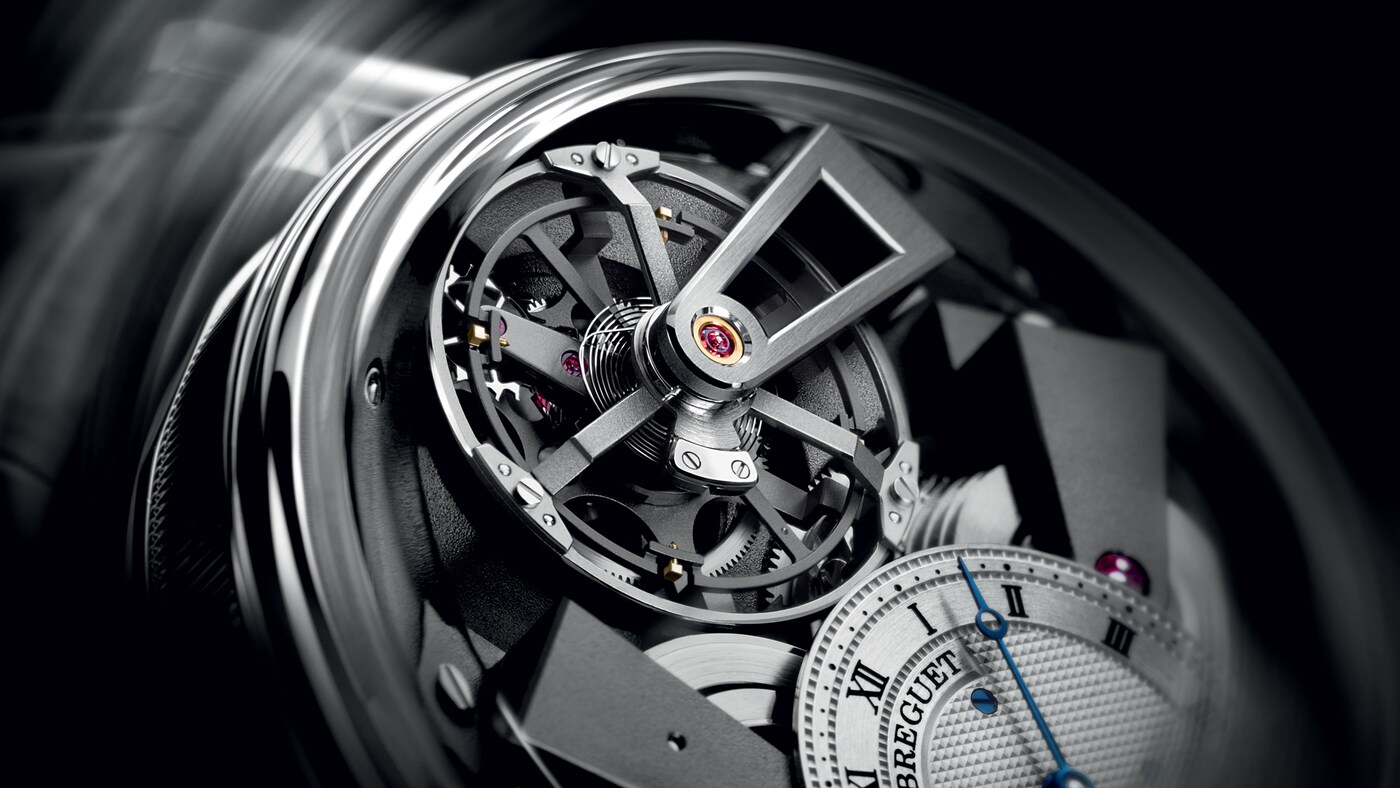
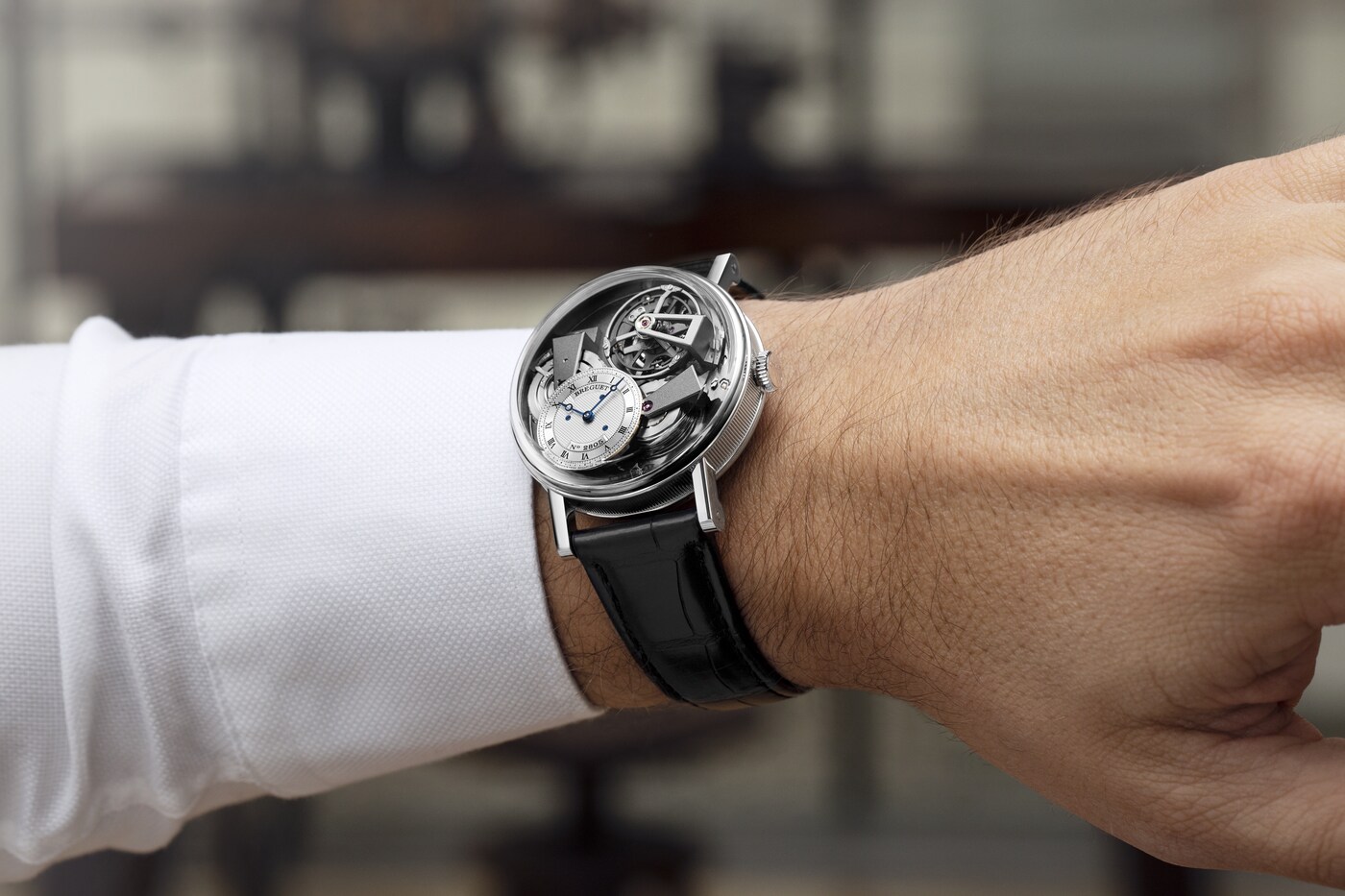
The appearance of the Tradition Tourbillon is deceptive. Four major elements present themselves: the tourbillon, the fusée, the barrel with its power reserve indicator and the dial. Visually simple, but bristling with 500 years of innovations.
Logically, our tour must begin with the heart of the watch, the tourbillon. The function of a tourbillon today is the same as it was when first conceived by Abraham-Louis Breguet two centuries ago, cancelling out the effects of gravity on the rate keeping of a watch. The key time keeping elements of a mechanical watch are the balance wheel, including its spiral, and the escapement. With each impulse delivered by the escapement to the balance wheel, it turns, or in the parlance of watchmakers, “swings”. The number of degrees of the swing is highly dependent on the characteristics of the spiral spring centered in the balance wheel.
Since a spring must have attachment points at both ends, perfect concentricity and distribution of weight is impossible to achieve. Said another way, it is impossible to place the center of gravity of the spiral at the axis of rotation of the balance wheel. As a result, when the wheel turns and the spiral spring winds and unwinds, the center of gravity of the spring will always be slightly displaced from the central axis of the balance wheel. In turn, the number of degrees that the balance wheel will rotate when it receives an impulse from the escapement, will vary with the vertical position of the watch.
If, for example, this slight displacement of the center of gravity is oriented downward, the degree of swing will be slightly diminished from what it would be were the weight perfectly centered. In watchmaking terms, this means that the amplitude (expressed in degrees of swing or rotation) in this position will be reduced. When the amplitude is reduced, the amount of time for the swing to be completed is reduced causing the watch to run slightly faster.
Conversely, if the center of gravity is displaced in an upward direction, that displacement will act to increase the amount of swing (amplitude) slowing down the rate of the watch. Breguet’s ingenious solution to this unavoidable dilemma where, depending upon the vertical orientation of the watch it will run faster or slower, was to design a mechanism that placed the entire balance wheel, spring, and escapement in a cage which constantly rotated. By steadily rotating these key time keeping components through an entire 360 degree circle, vertical positional errors are cancelled, as the timekeeping components are continuously rotated through both increased and decreased rate positions.
Breguet named his invention the “tourbillon” to describe the combination of the two sorts of rotation brought together, the swing of the balance wheel and rotation of the cage. That term ever since has been universally accepted and adopted by the entire watchmaking industry.
In its Classique Collection Breguet has offered several different tourbillon designs. However, the designs of Breguet’s Tradition Collection are anchored in the historical timepieces created by Abraham-Louis Breguet. Thus, the creation of a tourbillon for the Tradition Collection called for a “new” conception, one tied to the original invention of two hundred years ago.
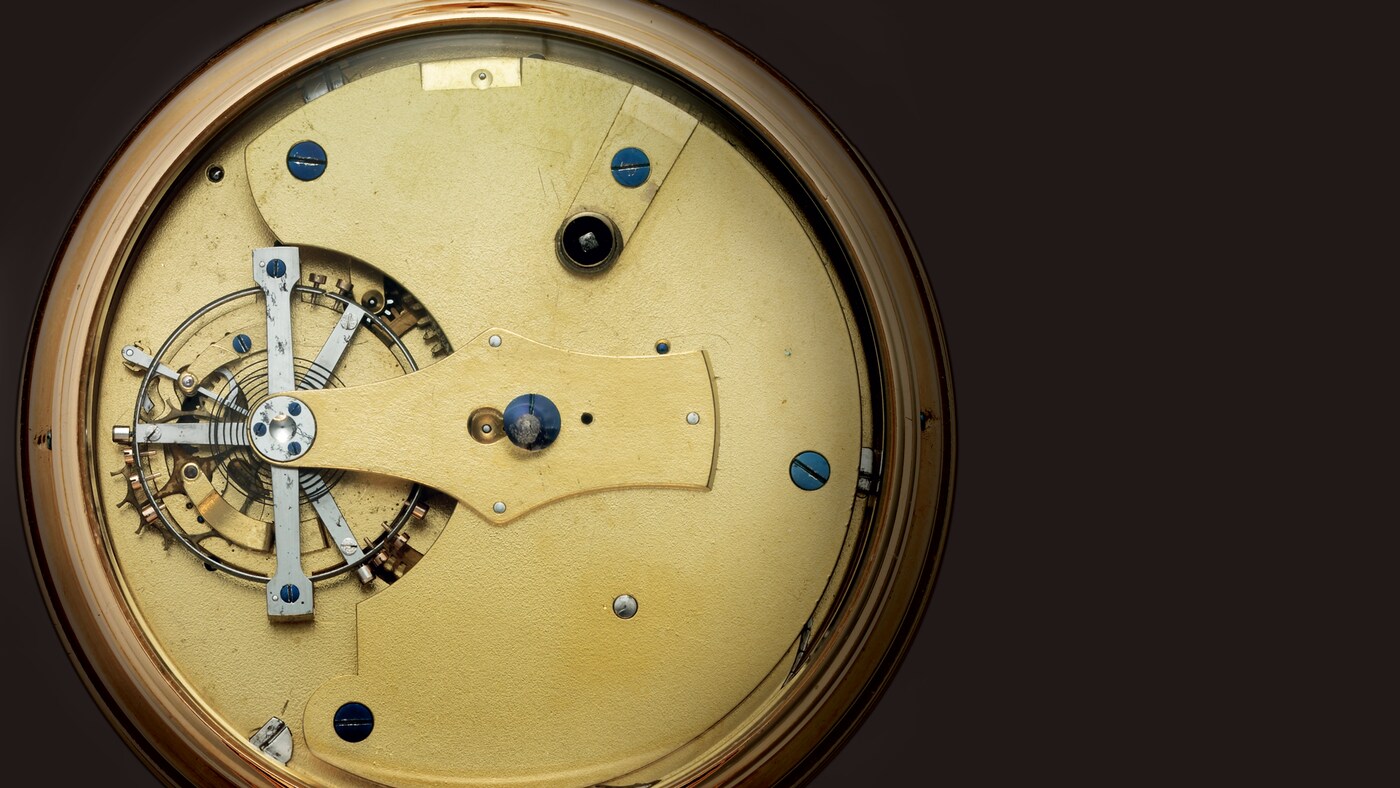
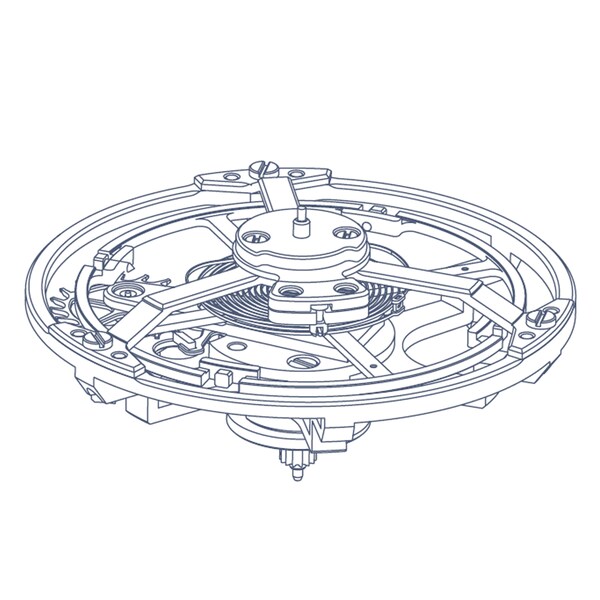
For that design, Breguet’s team turned to the drawings submitted in support of Abraham-Louis Breguet’s revolutionary 1801 patent. Those illustrations showed a tourbillon cage suspended between a bottom plate and an upper cantilever bridge. The cage itself had but two arms, that in profile, were horizontal across the top, and after a short vertical drop at the outer edges, sloped inward toward the center.
All of these original patent elements were carried over to the Tradition Tourbillon with but two modifications. First, the cantilever upper bridge in the patent application was solid; in the Tradition implementation it has been sculpted out in the center to open up the tourbillon below to better viewing. Second, for greater stability, the cage has been constructed with three upper arms instead of two to achieve greater resistance to shock. Enhancing robustness further, the cage utilizes six lower arms.
Although the basic architecture of the Tradition Tourbillon has remained faithful to the descriptions set out in the 1801 patent, modern technology was brought to bear on the implementation. Instead of fashioning the cage out of steel and the balance wheel out of steel or brass, the Tradition Tourbillon has constructed all the principal components in titanium (only the anchor bridge is brass).
Modern Breguet has been granted a patent for these constructs which offer several advantages over both those used by Abraham-Louis Breguet originally and those generally used elsewhere in the industry. Because titanium is lighter than conventional materials, less energy is required to rotate the cage and swing the balance wheel. This helps increase the power reserve of the watch.
Further, because the balance wheel is lighter, its inertia is less, which improves rate keeping performance. Aesthetics benefit as well. To balance visually the appearance of watch, Breguet sought to make the tourbillon cage enormous in size so as to be equal in diameter to the dial which is posed adjacent to it. That appearance could only be achieved through the use of an advanced material like titanium.
Modern technology adds a further improvement to the tourbillon/balance assembly. The spiral has been fashioned out of silicium. Not only does the use of this material produce a perfect shape, but it is resistant to the effects of residual magnetism. When a metallic spiral is exposed to a significant magnetic field, it is prone to magnetization. That, in turn, alters the characteristics of the spiral, changing the running rate of the watch. Silicium, a non-magnetic material, is not subject to these effects.
One other element of the spiral draws upon another A.-L. Breguet invention. The Tradition Tourbillon’s spiral incorporates a Breguet overcoil. The outer end of the balance wheel’s spiral has been turned upwards, above the plane of the remainder of the spiral, and inwards. This end design, termed by watchmakers as a “terminal curve” or “curb”, developed by Breguet in 1795 helps to center the weight of the spiral in comparison to standard flat designs. This minimizes the effects of gravity on rate keeping. Of course, the tourbillon itself, works to cancel out whatever errors remain. Breguet’s silicium spiral has been awarded a patent.
As our tour proceeds to the next major element, the clock turns back another 300 years. One of watchmaking’s greatest challenges is isochronism. This term speaks to the problem of a watch maintaining a constant running rate as the watch’s barrel is depleted. Although the solutions are difficult to achieve, the problem presents itself intuitively. When the mainspring in the barrel is fully wound, the force it delivers to the rate keeping elements of the watch (balance wheel and escapement) is higher than what it will deliver when it is nearly completely unwound. It is obvious that the running rate of the watch will correspondingly change between these two conditions.
Conversely, if a watchmaker can devise a method to keep constant the force delivered to the balance wheel and escapement, better accuracy over the full power reserve of the watch can be obtained.
If you are mechanically inclined, a question might pop immediately to mind: with a chain of this refinement and delicacy, how is it protected against breakage as a result of over-zealous winding?
The answer lies in an ingenious blocking system.
The winding stem of the watch is connected through a gear train to the fusée. As the fusée turns, winding the barrel via the chain, a seven tooth gear (with six small teeth and one very large tooth) turns along with it.
Just before the barrel is fully wound, so that continued winding of fusée would risk breaking the chain as the barrel could wind no further, the single extra-long tooth of the seven tooth gear drops into a slot on the fusée blocking any further turning. The chain is, thus, fully protected against breakage from over winding. There is yet another technical challenge to the construction of a fusée in a timepiece.
How may the barrel be rewound via the fusée and chain while the watch is running?
Previous designs have depended upon a spring built into the fusée. With these designs, during the time when the watch is being rewound, the spring supplies power to the escapement. Breguet seized upon a more elegant solution that dispenses with a supplemental spring. In La Tradition Tourbillon a differential has been incorporated within the fusée.
The key attribute of a differential that makes it ideal for this application is its ability to combine rotation from two different sources into one output. In this case, the output of the differential is connected to the tourbillon; one of the inputs comes from the barrel (via the chain) and the other from the crown.
During normal running, only the input from the barrel/chain is active. When the watch is being rewound, it is the rotation from the crown, routed through the differential that supplies the energy to the tourbillon, while at the same time it also rewinds the barrel through the chain.
Throughout the history of watchmaking there have been other constant force systems which have been developed. Indeed Abraham-Louis Breguet designed one pioneering constant force mechanism in 1798, which inserted a second escapement system between the barrel and the rate keeping elements of the watch.
However, the fusée construction enjoys an enormous technical advantage over other constant force approaches. Unlike other constant force systems, the fusée and chain does not itself consume extra energy and, therefore, does not adversely affect the power reserve of the watch.
Thus, although the fusée and its chain are time consuming to build and demand painstaking hand work, it stands out as the finest way to implement constant force performance.
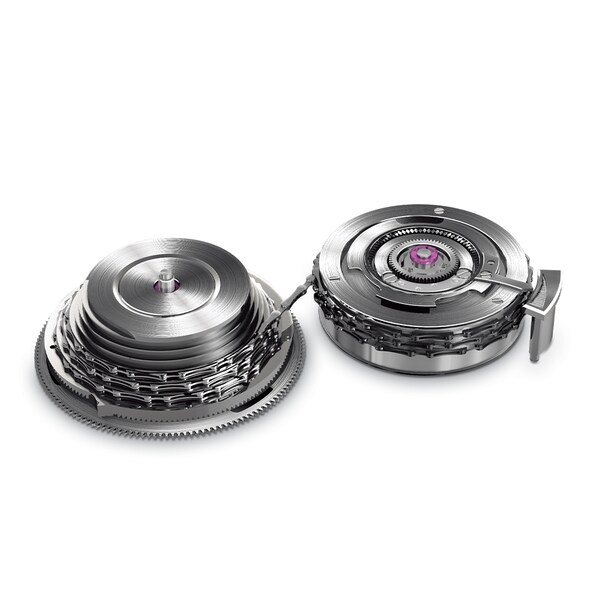
The third stop on our tour of La Tradition Tourbillon takes us to the barrel. Here Breguet has employed several unusual designs.
First, the barrel contains two mainsprings stacked one atop the other and wound in parallel. By stacking the springs, the barrel is significantly taller than conventional single spring designs. Far from being a drawback, this increased height provides both technical and aesthetic advantages.
Mechanically, the extra height allows the chain to wind and unwind while remaining parallel to the plane of the watch, as it wraps around the tall cylindrical surface of the barrel in the same manner that it engages the seven levels of the fusée.
Artistically, the elevated barrel balances visually with the height of the fusée and the tourbillon.
The second unusual feature of the barrel is the placement of the power reserve indication directly on top of the barrel drum. Beyond the complexity of this construction, for which Breguet has been granted a patent, the location follows compelling logic.
A power reserve indicator measures the state of wind of the mainspring or, in this case, mainsprings.
What better place to display that information than on top of the component being measured?
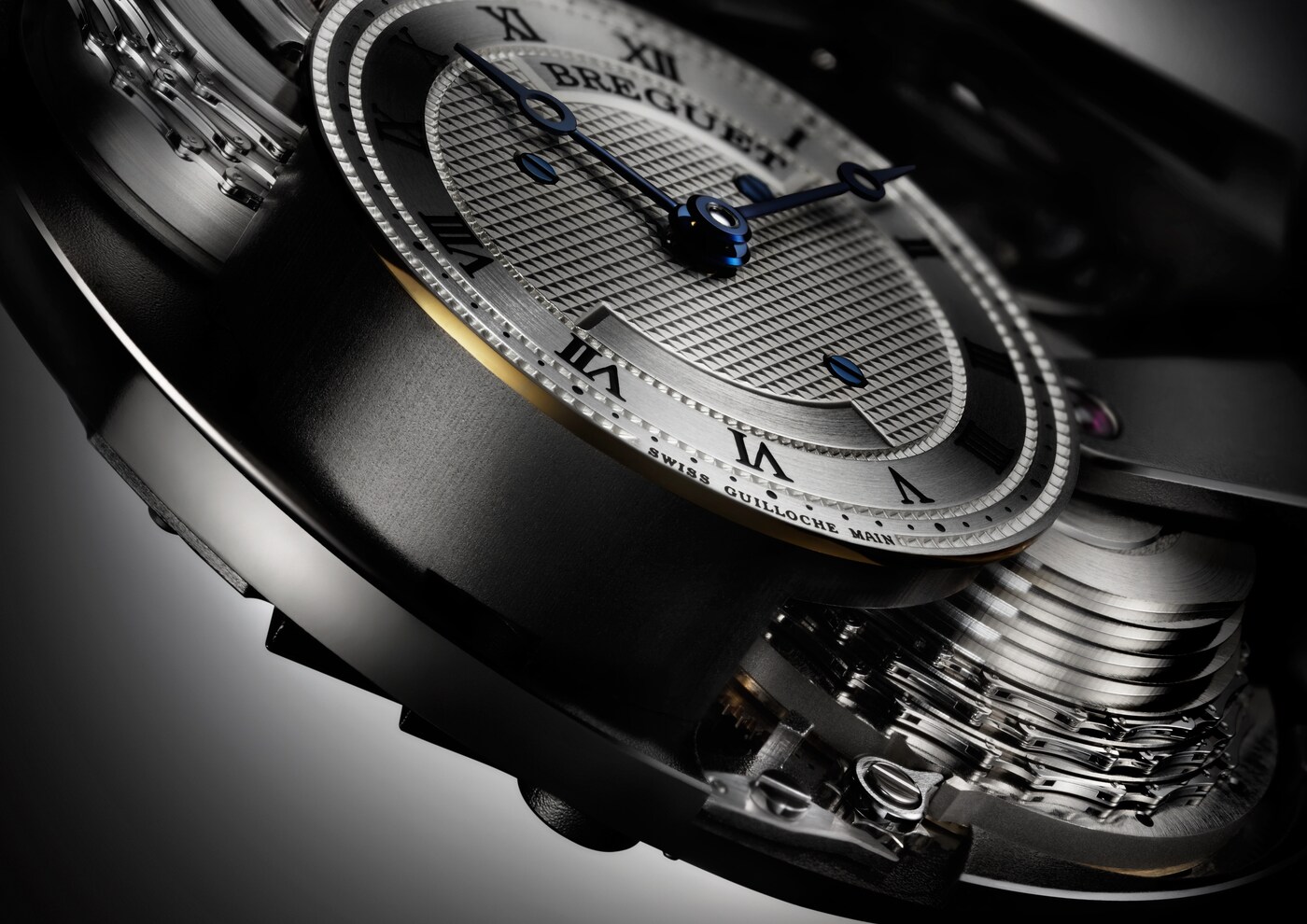
If La Tradition Tourbillon is unquestionably a technical tour de force, the considerable effort devoted to its construction has not distracted Breguet’s designers from purely aesthetic concerns, as evidenced by the sapphire crystal.
The crystal is dramatically domed, recalling the classic forms found on timepieces from the era of Abraham-Louis Breguet.
Creating this exceptional curvature requires painstaking finishing. After being formed, the sapphire must be cut with extreme precision so that it fits perfectly within the slim bezel.
Similarly, the placement of the principal elements of the watch — the tourbillon, fusée, dial and barrel — was the subject of extensive study.
Rather than arranging the flow of these components around a dial positioned at either 12 o’clock or 6 o’clock, the design team concluded that the watch would possess a nobler appearance if the entire composition were rotated approximately 30 degrees from what would normally be considered the conventional orientation.