
Principles of the Tourbillon
by 蒙提.赫爾曼Certainly, two measures of the importance of an invention must be the period that it has endured and the degree to which others have flocked to imitate it.
In the case of the tourbillon, patented by founder Abraham-Louis Breguet in 1801, both criteria are met in abundance. Not only is it prized well over two centuries after its creation, but at one contemporary count well over 100 watch brands claimed to offer a tourbillon in their collections, even if most were obliged to have someone else develop and build it for them.
Further adding to the luster of the tourbillon is the profile of its very name in the lexicon of watchmaking. The origin of the name came from its creator. Breguet, likening the motion of its components to that of the planets, affixed the word “tourbillon” to his invention, a reference that has withstood the test of time as powerfully as the invention itself.

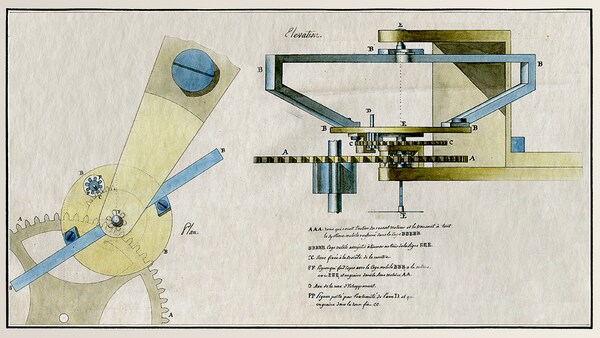
Up:
Excerpt from Breguet’s 1801 tourbillon patent.
Even as it has come to represent one of the revered pinnacles of fine watchmaking and is spoken of widely by collectors across the globe, how many truly understand its workings? Many references to tourbillons mention that the construction is meant to counteract the effects of gravity upon the rate-keeping of a watch. Seldom does the explanation go deeper than that. What are those effects of gravity? How do they impact the running of a timepiece? Finally, how does the tourbillon address those effects?
To understand the gravitational issues, and, as well, grasp as how the tourbillon mechanism approaches them, let’s begin with a brief review of fundamentals. The key innovation that made pocket watches and, later, wristwatches possible was the hairspring, invented by Dutch mathematician, physicist, and astronomer Christiaan Huygens in 1675.
This work, building upon the footing of Galileo’s studies, flowed from his examination of pendulum clocks. There was a progression in his work. Studying the physics of pendulums led him to invent the hairspring, following which he developed a pocket watch utilizing his hairspring invention. His analysis of pendulums and later of hairsprings considered them as oscillators. In particular, his research focused on their anisochronous properties, that is to say the way in which the period of the swing, that is to say its rate, would vary with the amplitude of the swing.
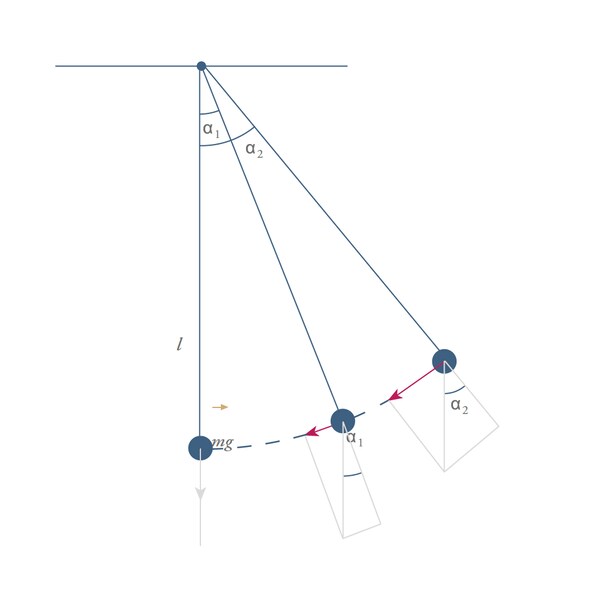
His study led him to theorize the properties of the restoring forces of both types of oscillators: pendulums and hairsprings. When a pendulum is displaced from center (its lowest position), gravity acts upon it, causing it to swing back towards the center. Gravity, thus, acts as restoring force to move the pendulum from its displaced position back toward the center.
If the angle of displacement (the angle defined by the position in relation to the lowest center position) is large, the restoring force will be proportionally less than at small displacements, since the tangential contribution of the gravitational pull on the pendulum to bring it back to the center will depend on the angle. Said another way, the restoring force for the pendulum is non-linear, varying according to the angle. Thus, the rate of the swings back and forth is affected by the angle of the swing. At large angles of swing, the rate is slower than at small angles of swing.
Up:
The study of the pendulum led to the development of the balance wheel and hairspring. Because the gravitational restoring force varies with the angle of displacement, a pendulum oscillator’s rate will vary as the angle changes.
For an ideal timekeeping oscillator, the rate would not vary with the angle. This ideal oscillator is termed “isochronous”. Because the rate of the pendulum swings in fact changes with the angle, a pendulum is not an isochronous oscillator. It only approaches the ideal of an isochronous oscillator where the rate would not change with the angle at small angles.
Huygens looked at a balance wheel with a hairspring as a more ideal oscillator. With an ideal hairspring, the restoring force should be proportional to the angle. Said another way, with the balance wheel rotated a certain number of degrees, the torque from an ideal hairspring should, in theory, be proportional to the number of degrees of rotation. The greater the angle of rotation, the greater the restoring force. In short, an ideal balance wheel and hairspring combination theoretically could be a perfectly isochronous oscillator where the rate would not change with the angle of rotation (which watchmakers refer to as “amplitude”).
As we shall see below, Huygens’ theoretically perfect isochronous oscillator turns out to have imperfections in the real world.
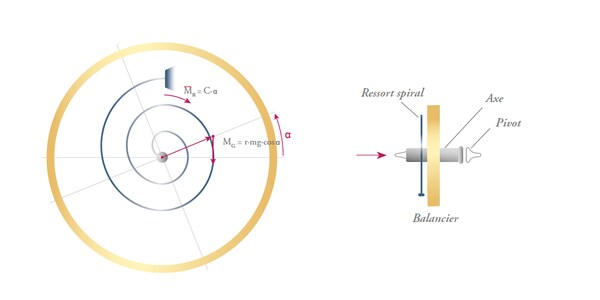
The standard modern construction of a watch’s balance wheel fixes it to a shaft (the watchmaking term is “axis” or “staff ”). That axis is generally supported by two jewels, one on each end, with a hole through which the axis passes. Those jewels are termed “pivots”. Finally, at each end there is a cap jewel. This construction allows the balance wheel to swing, or, oscillate freely with minimum friction.
Up:
The rate of an idealized balance wheel/hairspring combination would remain constant with changes in the angle. However, in the real world, there are pertubating torques induced by the displacement of the center of gravity from the center of rotation.
To understand the tourbillon, first it is important to examine how gravity affects the operation of a watch’s balance wheel oscillator. Abraham-Louis Breguet’s study of the balance wheel led him to identify three major factors contributing to gravity induced errors: perturbating torques, wear/ friction, and lubrication. Quoting from his 1801 patent application:
«By means of this invention, I have succeeded in cancelling out by compensation the anomalies due to the different positions of the centres of gravity of the regulator movement”; in distributing the friction over all parts of the circumference of the pivots of this regulator and the holes in which these pivots move, in such a way as to ensure that the lubrication of the parts that rub together should remain constant despite the coagulation of oils; and finally in eliminating many other sources of error that influence the precision of the movement to varying degrees, which the art (of horology) could only so far attain with a great deal of trial and error and even often with uncertainty of success.»
His insights were profound as they still guide watchmakers today. We examine each.
Perturbating torques.
This effect arises from the construction of the balance wheel and its hairspring. Every hairspring takes the form of a spiral which has two ends, one attached to the balance staff via a collet, while far end is fixed to an arm. There are two aspects of the construction that result in slight displacements of the center of gravity from the ideal of being centered on the axis of rotation.
The first arises from the fixing of the outer end of the spiral. As its fixation necessarily does not complete a full circle, the center of gravity will be shifted slightly away from the center. Abraham-Louis Breguet recognized that this displacement departed from the ideal and ameliorated it with another of his inventions, the “overcoil”, which today bears his name so that watchmakers refer to it as a “Breguet overcoil”. Instead of attaching the far end of the spiral to an arm, fixing its position adjacent to the outer portion of the spiral, Breguet finely shaped the spiral to bend the outer portion upwards above the main portion of the spiral, and move the attachment point inwards.
This upwards bend above the main portion (hence the term “over”) has the effect of moving the center of gravity of the spiral closer to the center of rotation, which is the balance staff. The second arises from the central areas of the spiral’s coil whose center of gravity is also slightly displaced from the axis of rotation.
An additional source of a displacement of the center of gravity can be the balance wheel itself. This displacement can arise if the balance is not perfectly poised which would thus move its center of gravity away from its central axis.
Breguet’s invention of the overcoil.
By bending the far end of the spiral to a position above and toward the center of the spiral, the center of gravity is moved closer to the center of rotation, thereby reducing gravitationally generated perturbating torques.
What is the significance of these displacements of the center of gravity?
Imagine the watch in a vertical position.
If the center of gravity of the spiral is below the staff, that small displacement will produce torques which conflict with the theoretically perfect restoring torques from the hairspring itself, since the force of gravity will tend to produce torques which subtract from the hairspring’s own restoring force over the first 180 degrees of the balance wheel’s rotation, until the displaced center of gravity reaches a position at its maximum height above the staff.
These torques from gravity will, as well, interfere with the impulse energy delivered by the escapement which causes the balance wheel to turn.
In short, the effect is torques which add to or subtract from the natural behavior of the hairspring and the impulse energy from the escapement, so as to speed up or slow down the rotation, which in turn speeds up or slows down the rate.
Both are departures from the ideal performance of the balance as an oscillator.
Similar analysis applies to imperfections in the poising of the balance wheel. The effects are the same as the displaced center of gravity of the hairspring.
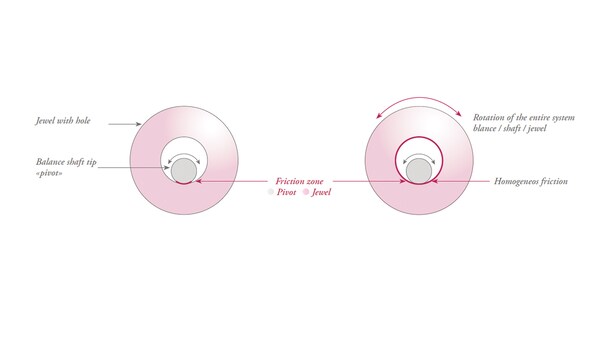
Wear/friction. The balance staff is supported at both ends with jeweled pivots. Although jeweled pivots greatly reduced the amount of friction in comparison with earlier constructions, they are not friction-free supports and, most importantly, several factors can cause a variance in the amount of friction according to the vertical position of the watch. These include slight imperfections in the form of the staff itself or the pivots and uneven wear of both. In those positions where the friction is lower, the amplitude will be greater than those where the friction is greater.
Lubrication. Over time, the distribution of lubrication in the pivots may become uneven. As in the case of wear/friction, this unevenness may result in greater friction in some vertical positions and less in others with corresponding effects on amplitude/rate.
Each of these gravitationally related small effects on rate/amplitude have two things in common. All occur when the watch and its balance wheel are in a vertical position and all vary depending upon the particular orientation of the watch. Indeed, recognizing this and other factors as well, it is common for watchmakers to examine the amplitude and rate in four vertical positions: crown up, crown down, crown left, crown right.
The idea underlying the tourbillon is to rotate the rate-keeping components, balance wheel, hairspring and escapement, over 360 degrees so that these small errors will average themselves out. With rotation, these elements will pass through positions where the rate is faster and where the rate is slower.
The underlying concept of the tourbillon, rotating the rate keeping components constantly over 360 degrees, sounds appealingly simple. Its implementation, however, represents one of watchmaking’s great challenges.
In order to accomplish the rotation, the balance wheel, hairspring and escapement are mounted within a carriage. The power train from the barrel of the watch delivers energy to the carriage so that it will rotate. Breguet’s genius was to integrate that rotation with the running of the balance wheel and escapement.
To do that, the escapement which is rotated with the carriage has a pinion engaged with a fixed wheel. The speed of rotation and the timing of the balance wheel’s oscillation are both metered by the locking and unlocking of the escapement.
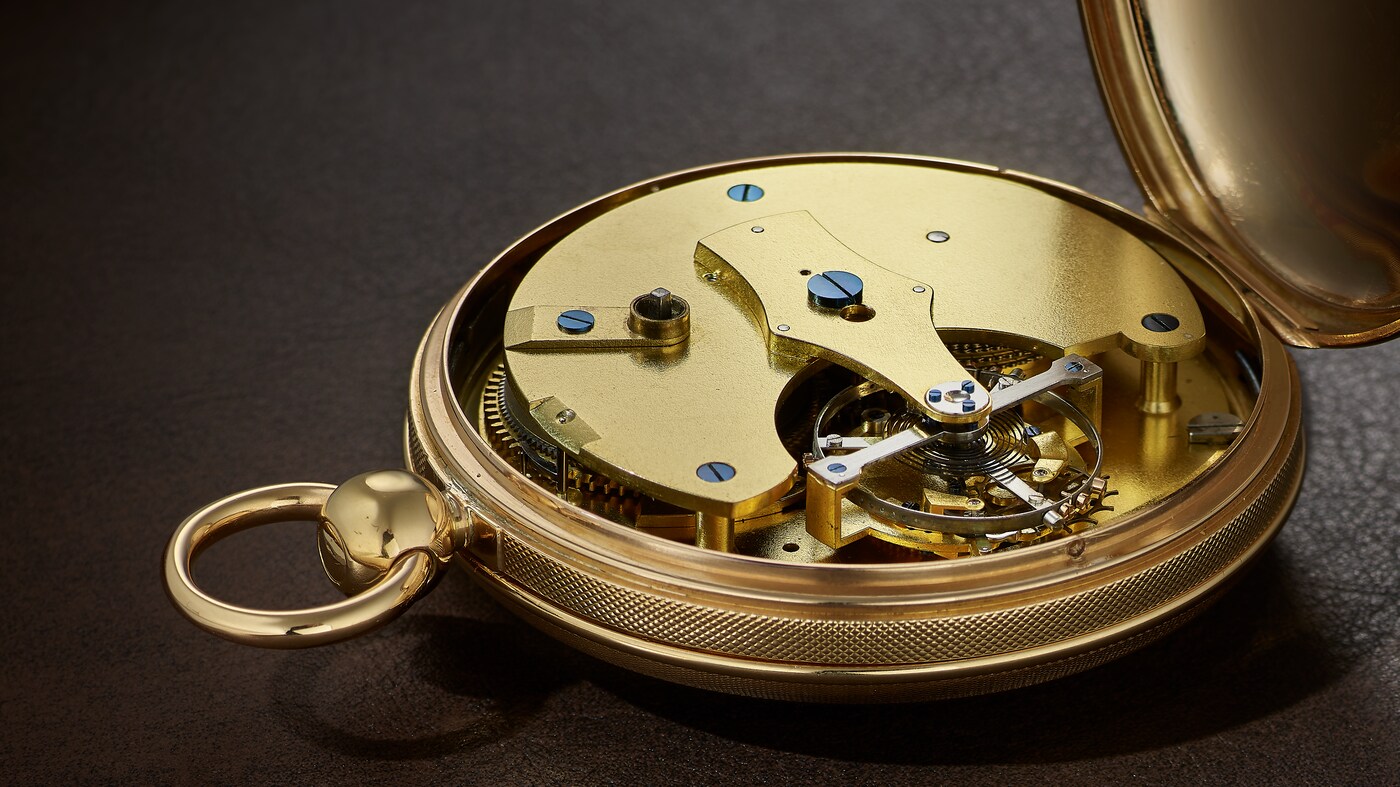
The most common construction of the system and one which is described in Breguet’s 1801 patent, features a pinion located beneath the carriage for the delivery of power from the barrel’s gear train. Also located beneath the carriage is the fixed wheel around which the entire assembly rotates.
There is one design imperative which flows from the design of a tourbillon. In a standard watch, the energy from the mainspring barrel powers the balance and escapement both of which are fixed in position. With the tourbillon, that energy must do double duty: not only powering the balance and escapement, but, as well, rotating the carriage.
This mandates careful design to minimize the weight of the assembly. For example, the combined weight of the carriage, balance, hairspring and escapement of Breguet’s tourbillons ranges from 0.290 to 0.895 gram.
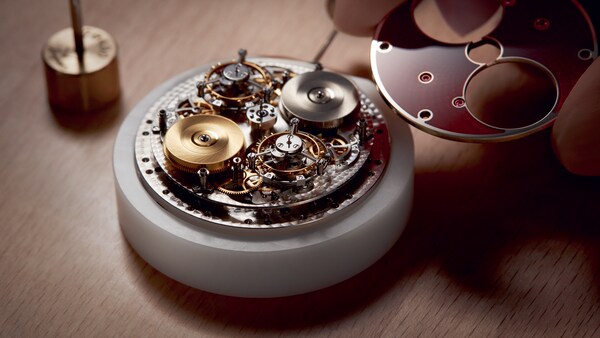
Today, almost all tourbillons, and all of the different varieties in the Breguet collections, rotate once per minute. Among other things, this allows fixing a seconds hand to the carriage and thus implementing a small seconds indication.
However, the theory of the tourbillon does not mandate a one-minute rotation. Other rotation frequencies can still accomplish the desired cancelation of rate errors. Although Breguet’s first tourbillon, No. 282, featured a one-minute tourbillon, he built others with different rates of rotation such as No. 2555 which rotated once every four minutes.
Fascinating for any aficionado to observe is a tourbillon running with the watch placed upon a Witschi machine which measures its rate in real time. The screen of the machine will trace a perfect sine wave as the carriage turns through the fast and slow positions.
In the slightly longer than two decades of his life following his invention, only 35 individual tourbillon pocket watches left Abraham-Louis Breguet’s Paris workshop on the Quai de l’Horloge. It is certain that in his wildest flights of fancy he never could have imagined the evolution of his invention that exists in the current collection.
Today’s Breguet has not allowed his invention to stagnate as a frozen museum piece. To the contrary, Breguet’s movement designers have focused their creative energies upon the tourbillon foundation to advance its design.
One example is Breguet’s extra-thin tourbillon which is found in the Classique Tourbillon Extra-Plat, La Marine Equation du Temps Tourbillon, Classique Tourbillon Extra-Plat and the Tourbillon Anniversaire.
In order to reduce the thickness of the movement, the extra flat construction changes the way in which energy is delivered to the carriage and the way that the escapement pinion engages the fixed wheel. Whereas the standard arrangement connects the carriage to the gear train of the watch via a pinion located underneath, the extra flat architecture delivers the power to the outside of the carriage. This eliminates the additional thickness of a pinion located below.
Similarly, to reduce thickness, instead of the escapement pinion engaged with a fixed wheel below the carriage, the escapement is engaged with an exterior toothed fixed ring.
Both of these evolutions in design, which bring modernity, leave unchanged the core principles of the tourbillon’s function and operation.
Up:
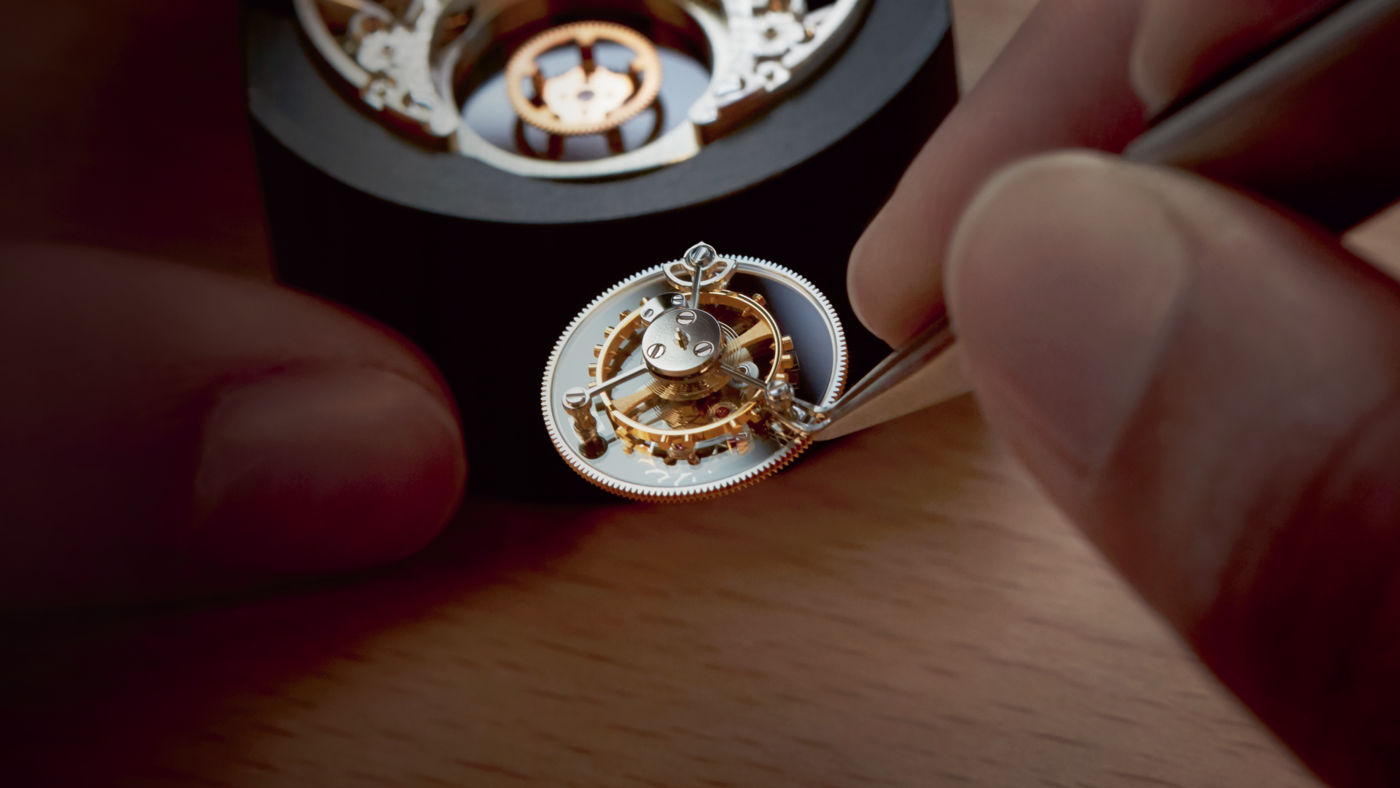
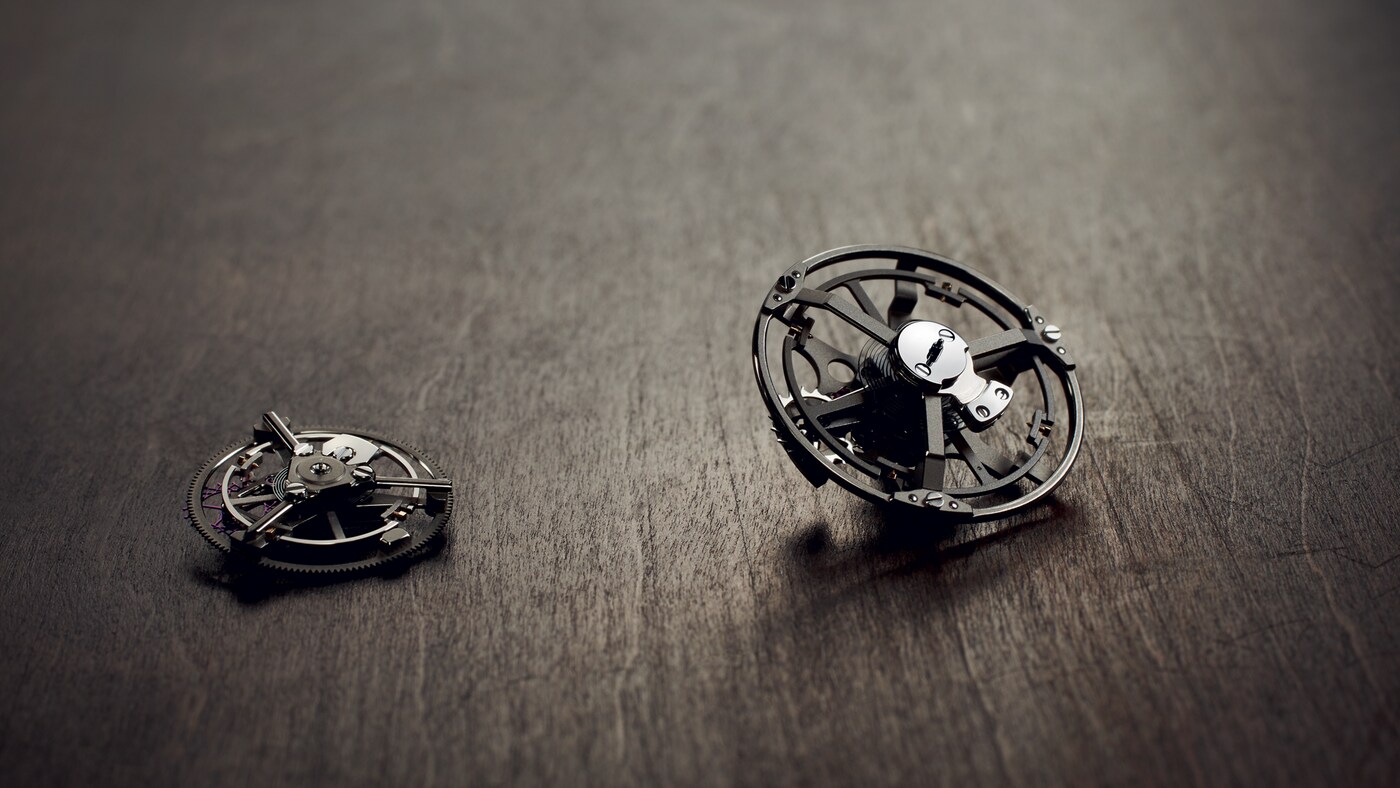
At left the tourbillon carriage of the Extra-flat Ref. 5377; at right the carriage of the La Tradition Tourbillon Ref. 7047.
Right:
At left the tourbillon carriage of the Extra-flat Ref. 5377; at right the carriage of the La Tradition Tourbillon Ref. 7047.
Up:
At left the tourbillon carriage of the Extra-flat Ref. 5377; at right the carriage of the La Tradition Tourbillon Ref. 7047.
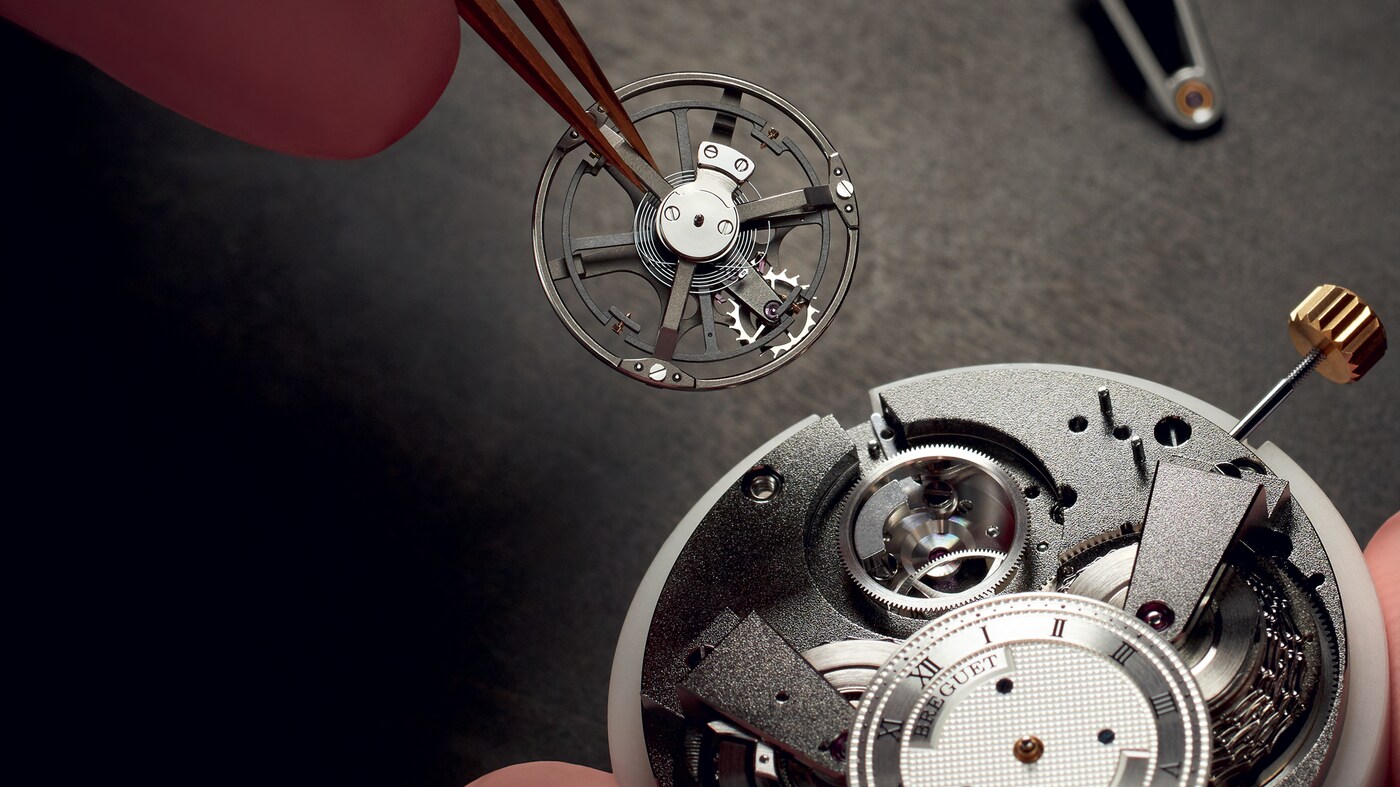
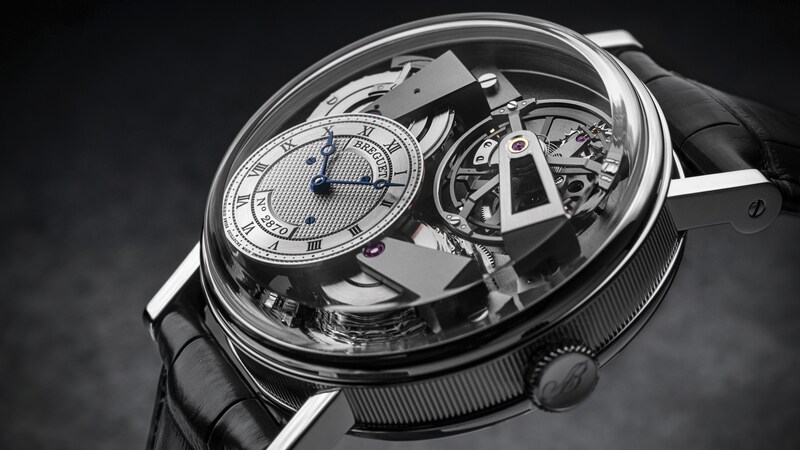
La Tradition Tourbillon introduces additional design advances. The diameters of the carriage and the balance wheel are extraordinarily large, done to harmonize the appearance of the dial side ensemble displaying the tourbillon, barrel, constant force fusee and, of course, the off-centered dial.
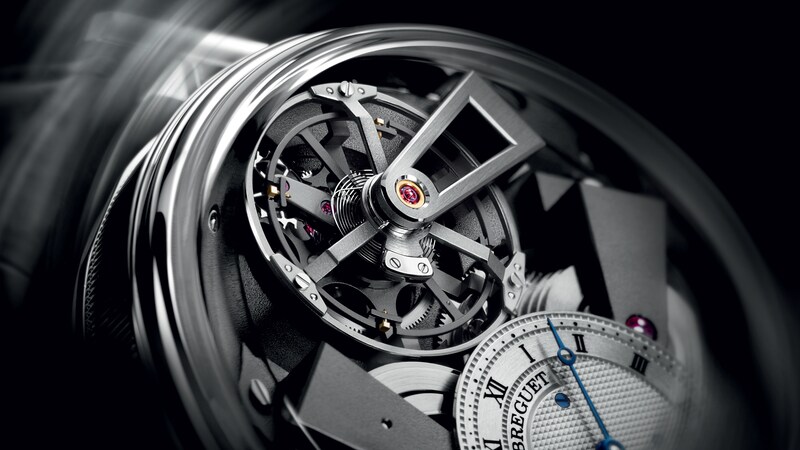
The design of the tourbillon itself is a blend of history and modernity. Drawing from the past, the shape of the arms of the tourbillon carriage resembles those described in the 1801 patent. Although the form of the arms was inspired by the patent, the number has been increased.
Breguet’s original design constructed the carriage with just two supporting arms. For reasons of robustness, La Tradition Tourbillon’s carriage increases that number to three upper arms and six lower arms.
Attention was devoted to the hairpsring. Not only are the effects of gravity mitigated by the rotation of the tourbillon itself, but Breguet has constructed the hairspring in silicon whose lighter weight also contributes to mitigation and, in one further measure, La Tradition Tourbillon incorporates a Breguet overcoil, which likewise enhances performance.
The silicon hairspring with its Breguet overcoil has been patented.
Both of these examples from today’s collection also showcase the integration of modern materials with the tourbillon. The silicon hairspring is of course a case in point. So, too, is the fashioning of the carriage and balance wheel in titanium. Its light weight in comparison to pre-existing materials lowers the inertia which enhances timekeeping performance and enables longer power reserves.
Breguet’s titanium balance wheel has been granted patent protection.
Reflecting on the evolution of the tourbillon in the more than two centuries since its creation, with the different varieties found in the current Breguet collection, what is remarkable is the continued vitality of Abraham-Louis Breguet’s profound insights into the challenges of chronometry that inspired his work.
Equally remarkable is the marriage between today’s technology and this historic invention.