
Technology On The Workbench: Titanium
by Jeffrey S. Kingston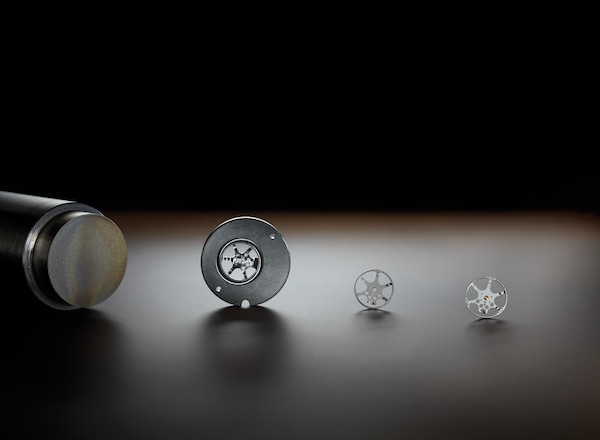
It is the ninth most abundant element in the Earth’s crust and is found essentially everywhere. Indeed, it is even present in essentially all living things. Each of us ingests 0.8 milligrams of it per day. Nonetheless, its official discovery did not occur until 1791 when William Gregor isolated it in Cornwall, England. Its physical properties are extraordinary; combining high strength with low density, high corrosion resistance, and amagnetism. Still the wait was until the 1930s, nearly a century and half more, before a commercially viable process to extract it from ore was developed. And longer still before it found its way into the horological universe. The material is titanium.

This is the second installment of our series Technology on the Workbench. As was the case in Part 1 which explored Breguet’s silicium innovations, examining Breguet’s pioneering work with titanium shows not only a similar degree of invention and the patents that follow from it, but the same spirit of using technology to advance the art of watchmaking while remaining true to its rich handcraft traditions.
The initial attraction to working with titanium was its unique combination of high strength and light weight (to be more scientifically precise “low density”). Pushing the boundaries of the strength/weight ratio through material selection has a long lineage at Breguet, albeit the most notable efforts in this direction came first not from the watch ateliers, but from Breguet aviation. Abraham-Louis Breguet’s great grandson, Louis Breguet, was a towering aeronautical figure with a career spanning half a century from his very first gyroplane (a precursor to today’s helicopters) in 1907 through the post World War II civil aviation boom. He developed the Breguet XIV reconnaissance biplane used in the first world war and was in the vanguard in the use of light weight aluminum in its construction.
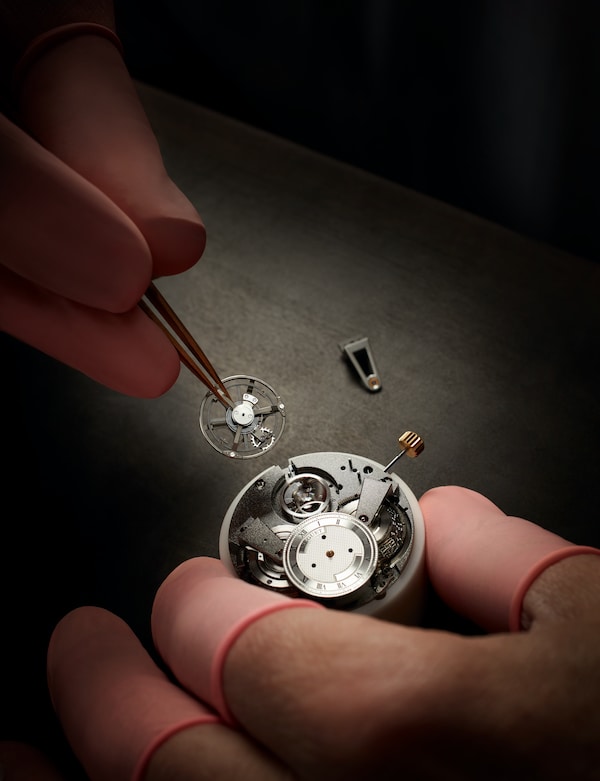
Up:
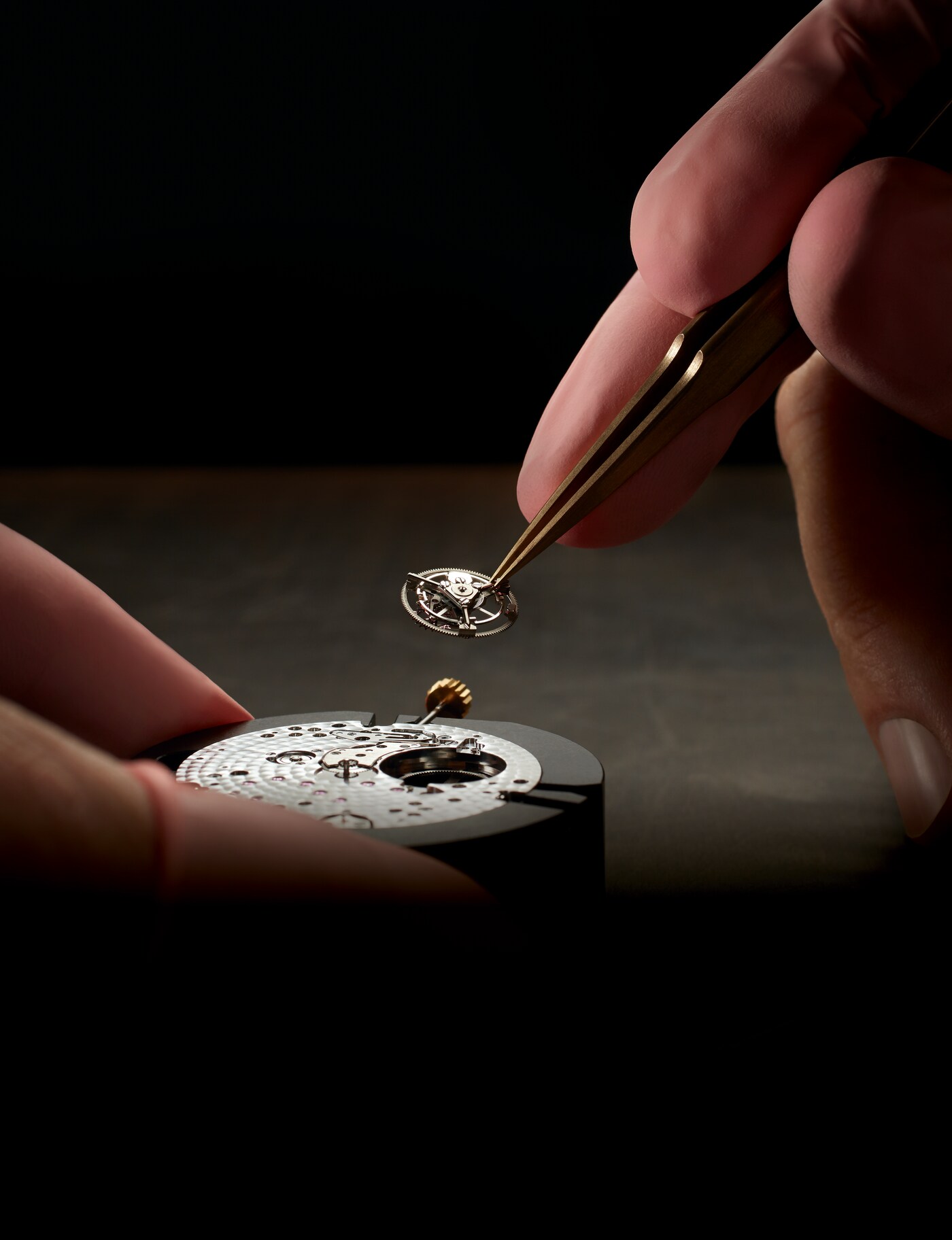
Mounting of the tourbillon assembly (titanium balance wheel and carriage) into the movement of La Tradition Tourbillon.
The timepiece that propelled modern Breguet to find a light weight material solution was La Tradition Tourbillon. This was imagined at the outset of its conception as a landmark in watchmaking that would link Breguet’s most modern forward thinking innovations with its signature inventions of the tourbillon, overcoil and constant force system.
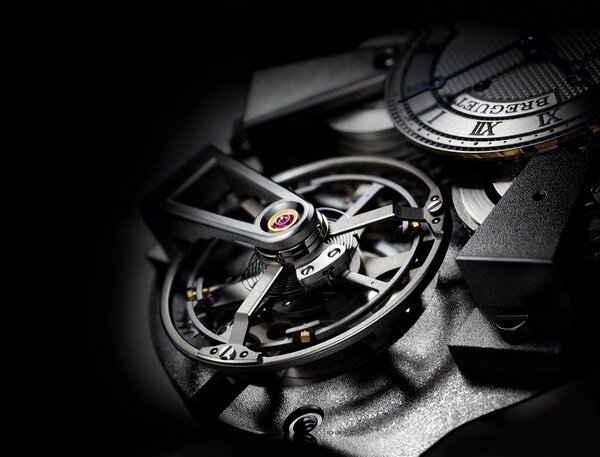
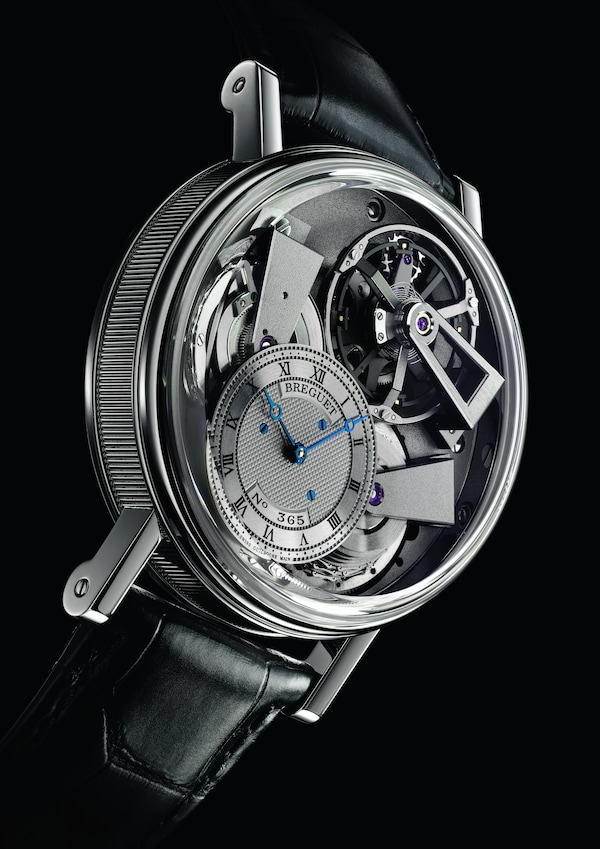
Placed within the Tradition Collection, its most important elements were to be located dial side so that they could be enjoyed while the watch was being worn. Front and center, therefore, were four major components: the tourbillon, the dial itself, the winding barrel and the constant force fusée. To achieve aesthetic balance among them, sent Breguet’s movement designers on the path of creating the largest diameter tourbillon for a wristwatch in Breguet’s history.
Up:
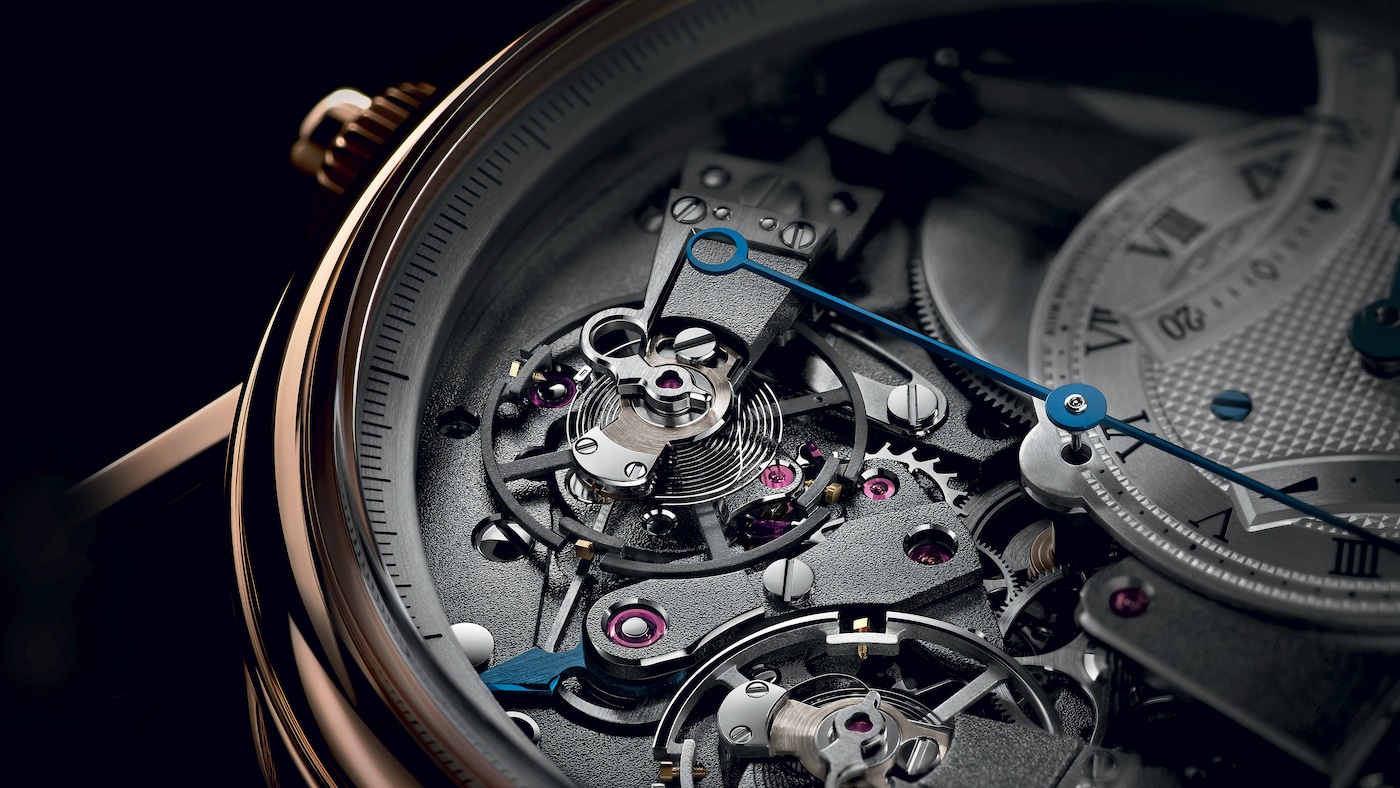
Close-up of La Tradition Tourbillon showing the fine anglage finishing of the titanium components.
Conventional approaches were soon rejected. To understand the challenge facing Breguet’s movement designers, consider for a moment how a tourbillon is constructed. The timekeeping elements of a watch consist of its balance wheel, balance spiral and the escapement. The locking and unlocking of the escapement, which establishes the rate, is timed by the back and forth oscillations (many refer to them as “swings”) of the balance wheel and its spiral. Gravity plays a role, as depending upon the vertical position of these elements, the watch’s rate may be slightly increased or decreased as gravity acts upon these components. Founder Abraham-Louis Breguet’s brilliant conception of the tourbillon, which he patented in 1801, addressed this issue of gravitationally induced errors. His solution placed the balance wheel, spiral and escapement within a carriage and rotated the ensemble constantly over 360 degrees, so as to compensate for these positional errors. Most commonly, today, that rotation is one minute in length, although Abraham-Louis Breguet constructed his tourbillons with a range of different rotation speeds.
Up:
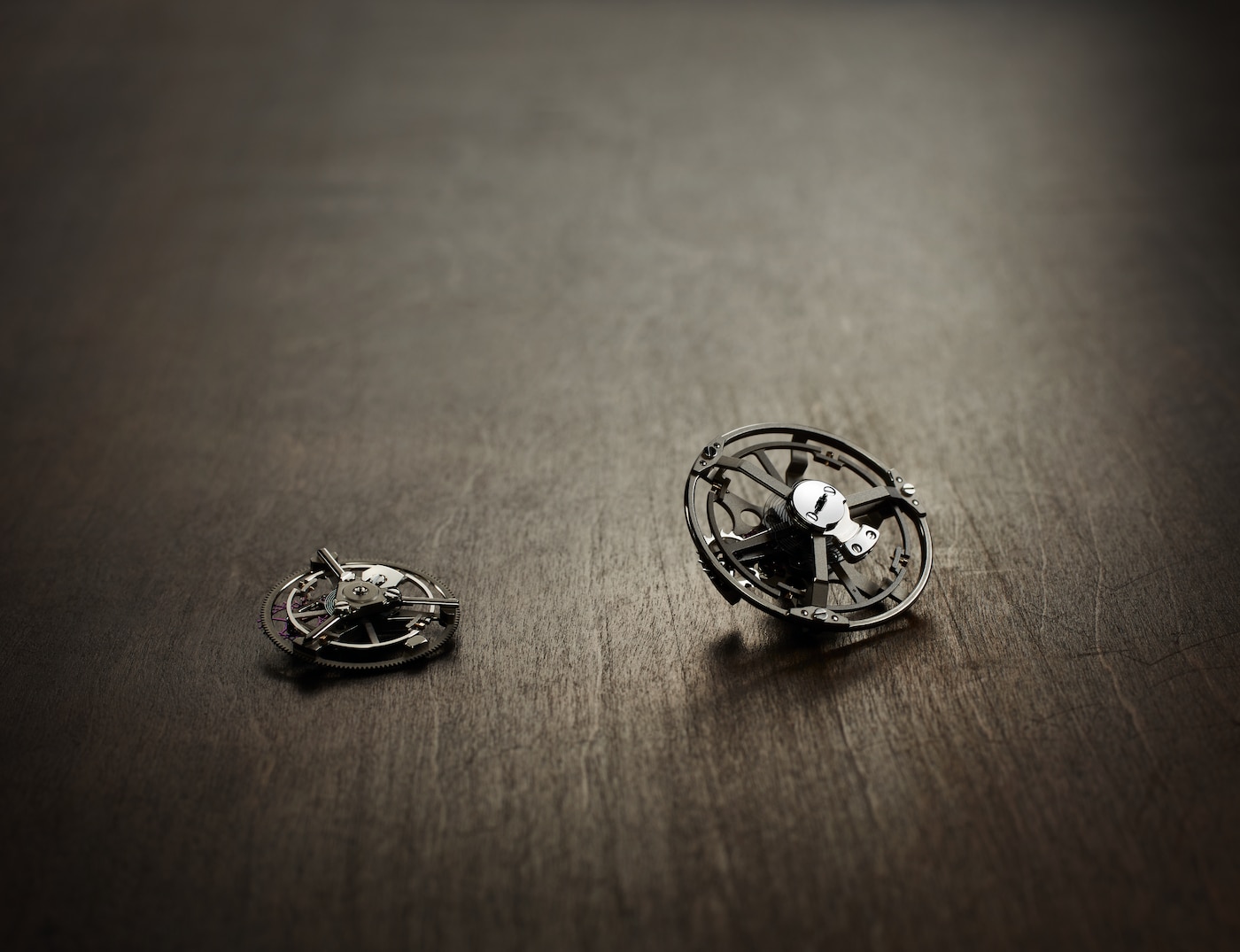
A side-by-side view of the tourbillon regulator featured in the Classique Tourbillon Extra-Plat and Tradition interpretations of this complication.
Right:
A side-by-side view of the tourbillon regulator featured in the Classique Tourbillon Extra-Plat and Tradition interpretations of this complication.
Up:
A side-by-side view of the tourbillon regulator featured in the Classique Tourbillon Extra-Plat and Tradition interpretations of this complication.
What Breguet’s designers confronted were a number of what, at the outset, appeared to be forbidding obstacles both with respect to the carriage and to the balance wheel. How could Breguet construct a robust large-diameter carriage, housing a large-diameter balance wheel and rotate the combination i) without requiring excessive torque and without consuming too much energy from the winding barrel, ii) without overly increasing rotational friction, and iii) without encountering unacceptable vulnerability from external shocks? With respect to the balance wheel itself, how to keep the same frequency if its inertia were increased because of the larger diameter (as explained in the following paragraph, an increase in the inertia of a balance wheel, decreases its frequency). Conventionally sized, as with the tourbillons found in Breguet’s Classique Collection, a carriage constructed of steel and a balance wheel fashioned with Glucydur, work flawlessly. But when the diameter of the cage is increased 40% from 12 mm to 16.8 mm and the balance wheel from 9.95 mm to 13.8 mm as was planned for the La Tradition Tourbillon, the demands of torque, energy consumption, rigidity, weight, friction and shock resistance would have increased dramatically unless a solution were found to reduce the mass.
Titanium’s extremely favorable strength/weight ratio illuminated the path forward. Indeed, this happy combination offers a teachable moment on movement design. The running rate of a watch is largely determined by two factors: the inertia of the balance wheel and the rigidity of the spiral. Since the characteristics of the spiral are usually a given, it is the first factor, inertia, to which designers devote their attention. Without resorting to the mathematical calculations and computers which are brought to bear in the design process, our everyday experiences illustrate core principles. We have all witnessed Olympic ice skaters performing spins. As the spin starts with arms outstretched, the skater’s inertia is great; then as arms are brought inward, inertia is reduced and the speed of rotation vastly increases. Two core ideas underlie this. First, the speed of rotation depends inversely with the amount of inertia so that as inertia is reduced, rotational speed increases. Second, inertia depends upon both mass and the radius of the mass. The greater the mass, the greater the inertia (a light weight skater can spin faster than a heavy one) and the larger the radius the greater the inertia (when the skater’s arms are outstretched, radius is increased; arms drawn inward, decreased). Imagine now a balance wheel using the lessons from our ice skater. Its inertia will depend upon both its radius (the greater the radius the greater the inertia) and its weight or mass (the heavier the balance wheel, the greater its inertia). Breguet’s movements regulate inertia in order to adjust the running rate of the watch. Its balance wheels are fitted with heavy gold screws which can be adjusted inwards (less inertia) or outwards (more inertia) to set the rate precisely.
Up:
The two balance wheels of the Tradition Chronographe Indépendent. In order to allow the two balances to run at different frequencies yet share a common diameter, the balance wheel for the chronograph is fashioned in titanium.
Right:
The two balance wheels of the Tradition Chronographe Indépendent. In order to allow the two balances to run at different frequencies yet share a common diameter, the balance wheel for the chronograph is fashioned in titanium.
Up:
The two balance wheels of the Tradition Chronographe Indépendent. In order to allow the two balances to run at different frequencies yet share a common diameter, the balance wheel for the chronograph is fashioned in titanium.
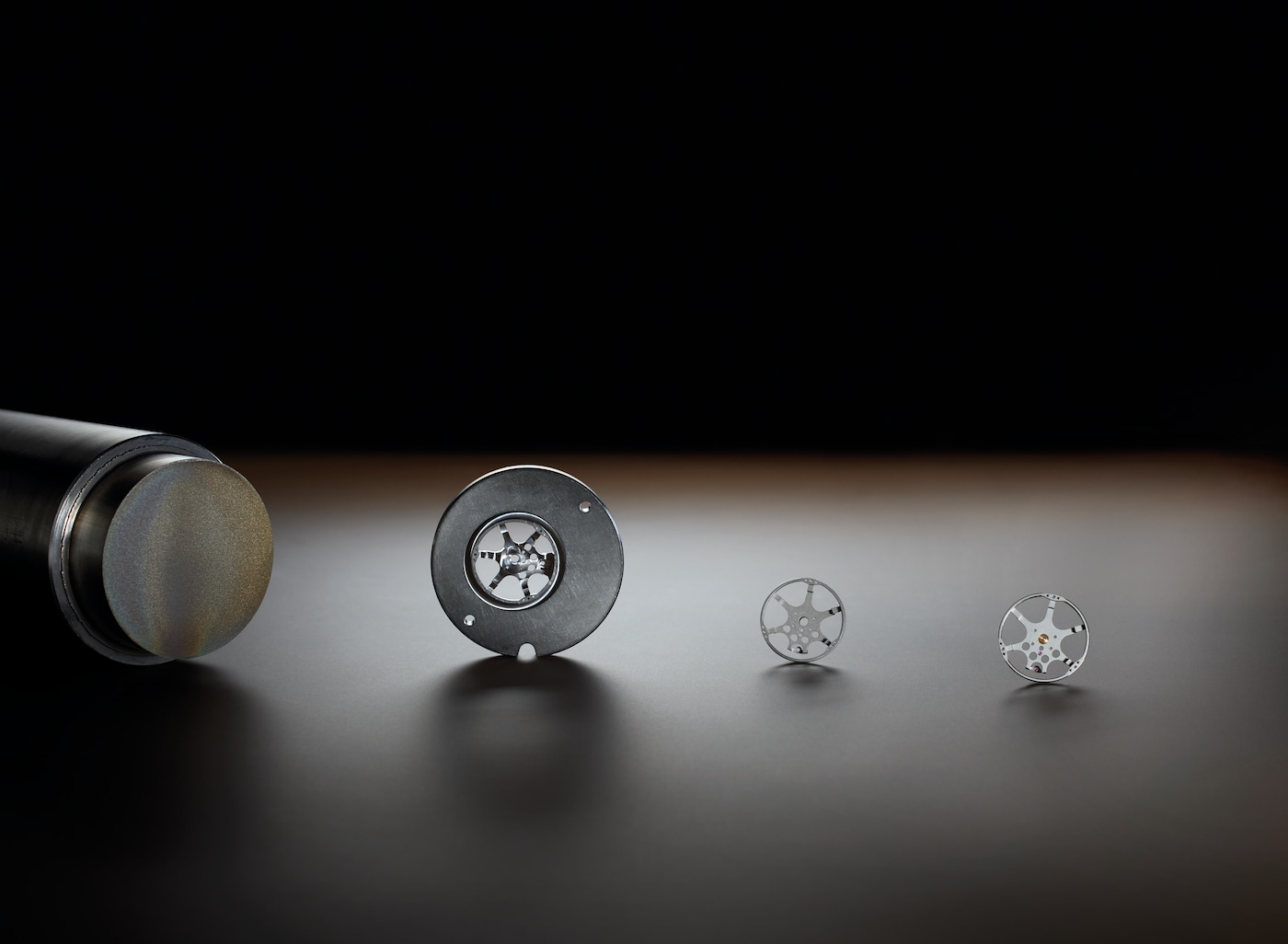
With a design goal of a large-radius balance wheel and, of course, a large-radius carriage to house it, Breguet’s movement designers began with one of the inertial factors already large: the radius. If the same materials were to be used as with the other tourbillons then in the collection, the cross sections of balance wheel and carriage would have to be greatly reduced in order to reduce the mass. That, of course, risked introducing fragility which could compromise robustness. Titanium presented itself as an ideal solution. As its density is half of that of the standard Glucydur for balances and less than steel, standard for the carriage, the reduction in mass compensated for the increase in radius. Indeed, titanium represented an idealized solution, since for a given level of inertia, its mass would be greatly reduced compared to pre-existing approaches. This is a favored combination because of all the other factors which are improved when mass is reduced: energy consumption, friction and shock resistance. For these reasons Breguet selected titanium both for the balance wheel and for the carriage. There was one other added bonus that titanium promised. Unlike steel, it is amagnetic. This pioneering innovation has been patented and is, therefore, exclusive to Breguet’s group.
The favorable inertia/mass ratio did not, however, drop the solution into the designers’ laps. Titanium is a very difficult material to fabricate. Not only did special tooling have to be developed, wear on the tools, necessitating frequent replacement of the cutting elements, makes its use more costly than the pre-existing conventional materials. Further, great precautions must be exercised during fabrication as the heat generated from cutting can cause the component to burst into flames.
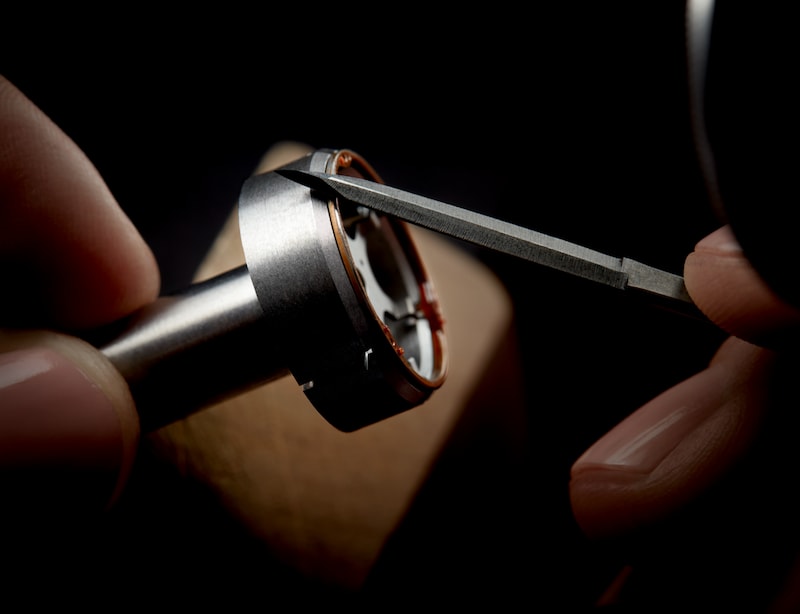
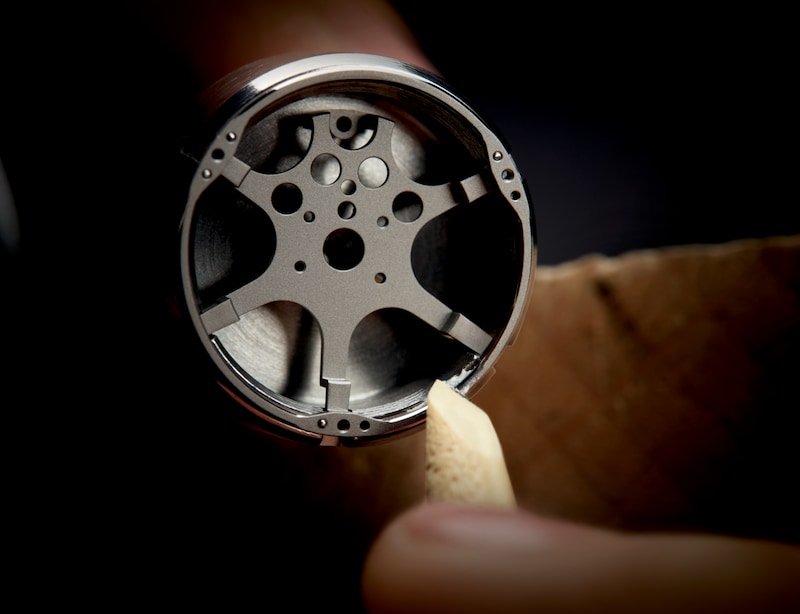
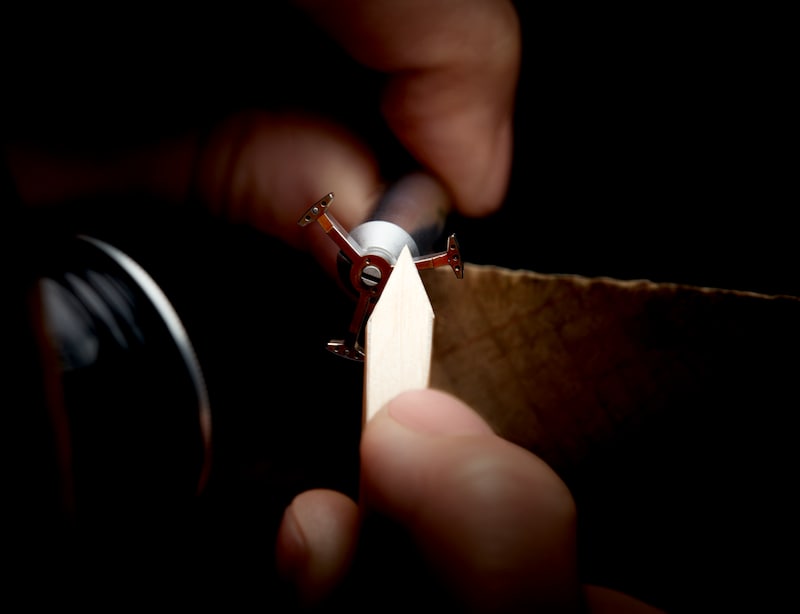
Breguet’s devotion to fine hand finishing likewise created challenges. On an haut de gamme timepiece like the Tradition Tourbillon, both the flat surfaces and the edges of movement components such as the tourbillon carriage are meticulously decorated by hand. With conventional materials, the methods reflect long-standing watchmaking traditions with the flat surfaces receiving a fine brushing and the edges beveled and polished (termed “anglage”), using a succession of ever finer files followed by a final polishing using wood combined with a fine abrasive. All of these traditional methods had to be completely revisited to take account of the particular characteristics of titanium. For the flat surfaces, Breguet developed a special sand blasting technique that required considerable trial and error to select the materials and pressures that would create the desired aesthetic without leaving undesirable residues. Anglage was even more complex. Both materials and techniques had to be adapted while at the same time remaining true to the basics of anglage achieved through hand-filing and polishing. Breguet’s finishers searched for both files and abrasives to be used with the final wood polishing that would be effective in beveling titanium. Not only were there challenges arising from titanium’s hardness, but hand techniques were also perfected to take account of titanium’s higher degree of flexibility than standard materials. The final result married the modernity of titanium with the grand traditions of Vallée de Joux fine finishing.
The end result was stunning; an extra large tourbillon, without compromise in performance, whose size visually balanced the three other components displayed on the dial side.
Up:
The tourbillon assembly for the Classique Tourbillon Extra-Plat. Note the teeth on the outside rim of the cage used to drive the assembly.
Right:
The tourbillon assembly for the Classique Tourbillon Extra-Plat. Note the teeth on the outside rim of the cage used to drive the assembly.
Up:
The tourbillon assembly for the Classique Tourbillon Extra-Plat. Note the teeth on the outside rim of the cage used to drive the assembly.
Similar considerations were in play during the design of the Classique Tourbillon Extra-Plat. Here the goal was to create an automatic winding tourbillon of breathtaking thinness. Breguet’s movement designers achieved that goal and surpassed it for the Tourbillon Extra-Plat movement is the world’s thinnest extra-flat automatic tourbillon at but 3 mm. Extra-flat construction imposed a unique set of design demands. Reducing the thickness of the movement, the tourbillon is not driven by a pinion located below the lower tourbillon bridge; instead the gear train from the winding barrel delivers power to teeth located on the outer ring of the carriage. For similar reasons of thinness, instead of engaging the escapement pinion with a fixed wheel mounted underneath the carriage, the escapement is engaged with an exterior mounted ring. In order to ensure the robustness and shock resistance of these two design innovations, Breguet’s movement designers sought to minimize the weight of the tourbillon assembly. That, of course, pointed to use of titanium for both the tourbillon carriage and the balance wheel. The light weight of this assembly requires less energy than with heavier alternatives and helps contribute to the extraordinary, for an extra-flat architecture, 80-hour power reserve.
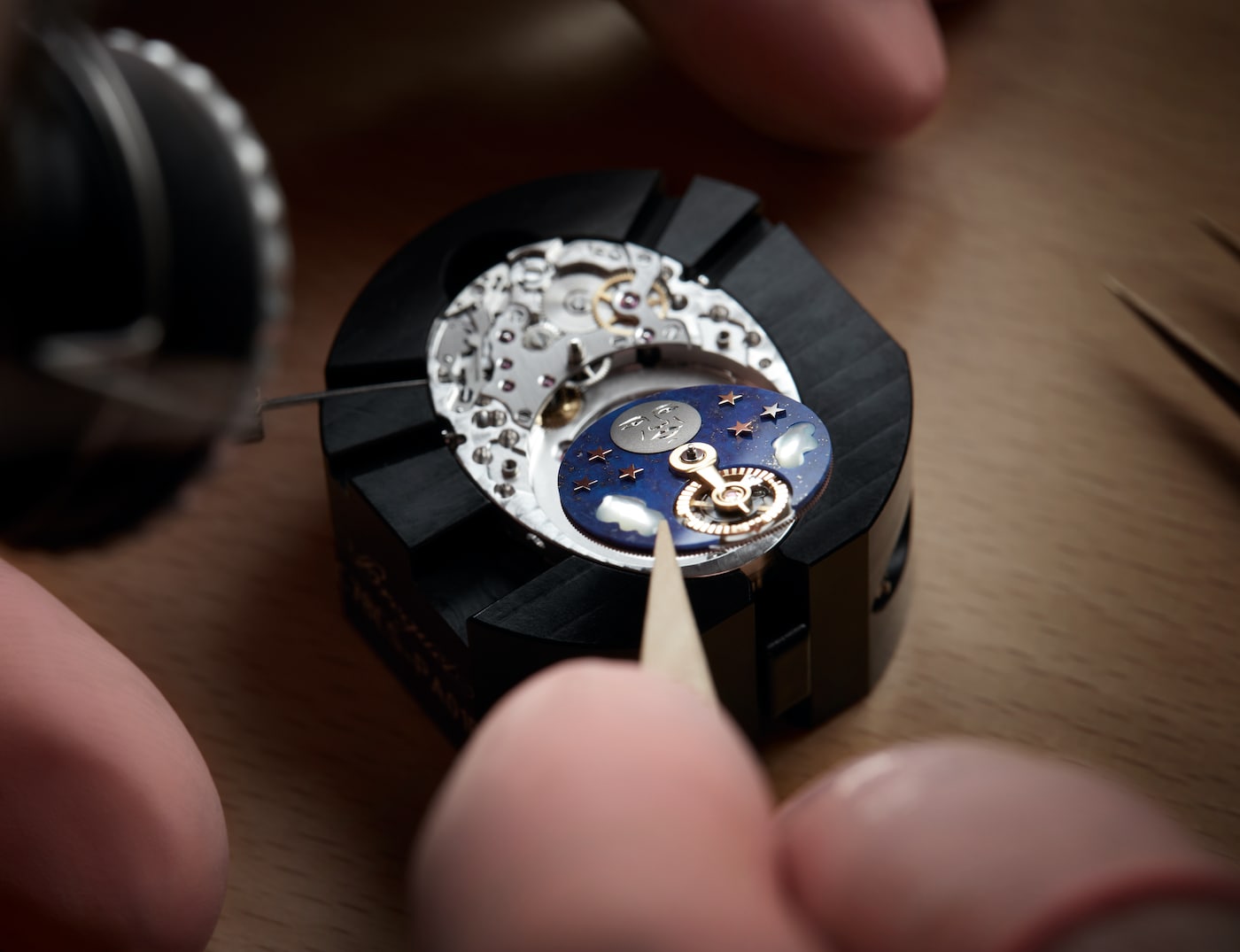
Up:
Mounting the lapis lazuli disk carrying the balance wheel into the Reine de Naples Jour / Nuit movement.
Right:
Mounting the lapis lazuli disk carrying the balance wheel into the Reine de Naples Jour / Nuit movement.
Up:
Mounting the lapis lazuli disk carrying the balance wheel into the Reine de Naples Jour / Nuit movement.
Titanium recommended itself for feminine timepieces as well. For the Reine de Naples Jour / Nuit, Breguet created a unique rotating day/night dial carrying the image of the moon and stars, symbolizing, of course, nighttime and the balance wheel representing the sun and supported by an upper golden bridge serving as a 24-hour hand. The disk itself is decorated in lapis lazuli (a semi-precious stone). The entire assembly is driven by the mainspring barrel and rotates constantly over 24 hours. Not only does this rotating disk carry the most vital elements of the movement, the balance and escapement, but it bears, as well, the relatively heavy decorative lapis disk which is, itself, embellished with gold stars and mother of pearl clouds. Titanium’s light weight lends itself well to the structural elements that support this elaborate display and Breguet’s designers turned to it for the plate elements used in rotation. There were two additional light metal elements brought to the Jour / Nuit. First was the Moon. Titanium was selected for the special luster that it acquires when polished. Second was the mounting disk for the lapis. As it was non-structural, aluminum was the choice.