
Classique Chronométrie
by Jeffrey S. Kingston
When scanning the horizon for watchmaking innovations, even for the most savvy of connoisseurs, it is easy to squeeze down the field of view to focus upon the domain of complications. New complications, traditional complications done in new ways, and, let’s not forget, combinations of complications.

However enchanting and exhilarating may be the Sturm und Drang of new complication announcements, the lesson of watchmaking history points in a different direction. Seen through the prism of time, the ranks of the most celebrated, enduring, and, at the end of the day, important, watchmaking innovations have been less in the area of complications but, rather, instead, have been dominated by those which have advanced the art of timekeeping precision. To cite but a few examples, look no further than the contributions to watchmaking accuracy from Abraham-Louis Breguet, the founder of Breguet, with his creation of the tourbillon, the Breguet overcoil, and the constant force escapement. Does anyone remember who developed the first perpetual calendar?
The Classique Chronométrie has been conceived with this perspective of watchmaking history; with it Breguet has brought a singular focus to revolutionize watch construction and set new standards for mechanical watch precision. Every element of the Classique Chronométrie is devoted to this goal and Breguet has pushed aside the temptations to add other elements or complications to the watch which might intrude upon or deflect attention from the primary objective of changing the rules for timekeeping performance. And as a testament to its ground breaking chronometry, each watch will be accompanied by a certificate certifying its precision.
The development path for the Classique Chronométrie took Breguet’s movement designers to unexpected places. If this were to be a timepiece that would raise the precision bar, its construction could not consist of mere tweaks and twists on standard solutions. Rather than focus on existing designs, the project team began by identifying known obstacles to precision and searching for new ways to overcome them. It was this wide-open approach that freed the development from convention and sent it down the path of free spun innovation. Result: no less than four patents are embodied in the 7400 movement that powers the Classique Chronométrie.
One of the first barriers to accuracy that the designers attacked was the suspension of the balance staff. The centerpiece for a watch’s timekeeping is the balance wheel and its spiral spring. Its back and forth rotations, generally spoken of as “swings” or “oscillations”, determine the rate of the watch. In many ways, these oscillations call to mind the swings of a pendulum used in most mechanical clocks.
For centuries the standard form of construction of the balance wheel has it mounted on a shaft, termed “balance staff”, the end of which is termed a “pivot” which is inserted into what are known as “pivot jewels”, rubies with a drilled-out hole. Generally there is a second jewel, known as a “cap jewel” that is placed against the tip of the pivot, on the outside top of the pivot jewels. The pivot jewels function as jeweled bearings. Although a huge technical leap when invented in early 1700’s, an advance that made possible adding a minute hand to watches that before only offered a rather inaccurate hour indication, and simply accepted by watchmakers for more than three hundred years therefollowing, this jeweled bearing design carries with it problems which adversely impact a watch’s precision. Primary among them is the fact that the frictional characteristics of the pivot jewels are dependent upon position.
When the watch is in a vertical position, the most important source of friction is the contact between the sides of the pivot, pressed by gravity, against the side walls of the pivot jewels; in a horizontal position it is the force of gravity pressing the bottom tip against the cap jewel. From this description alone it can be intuitively seen that the degree and effects of friction in vertical positions will differ from those in horizontal positions.
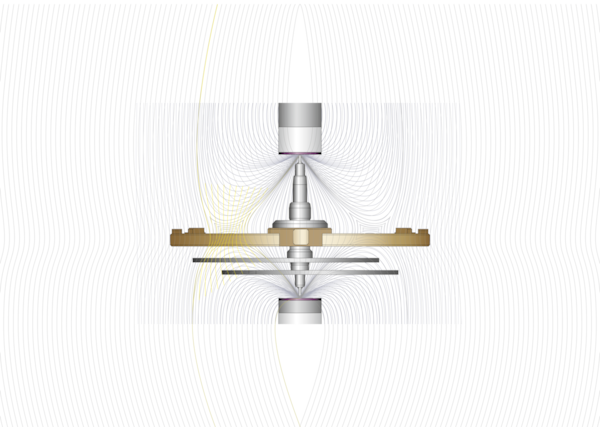
Overcoming these positional friction disparities led Breguet to a completely new and unanticipated method for mounting the balance staff: one employing magnetism. Instead of inserting each end of the balance staff into a hollowed out pivot jewel, each tip merely touches an endstone jewel formed with a shallow depression. Mounted behind each endstone is a powerful micro magnet which, because it induces a magnetic field in the staff itself, both pulls the balance staff towards the jewel, and exerts recentering forces on the staff should there be a slight displacement of position. What is created is an instantaneously self-correcting system.

The advantages of this revolutionary construction are manifold. First and foremost, is the effective elimination of frictional differences as the position of the watch is changed. It is remarkable to note that even as the watch is inverted from one horizontal position to another, the balance staff remains in contact with same endstone, the one positioned on the dial side of the movement. This is because the magnetic field created between the magnets is stronger than gravity. Said another way, the magnetic force felt by the staff is stronger than the gravitational weight of the whole balance. If you want to think of this as a highly localized “artificial gravity” for the balance staff, go ahead. A second major advantage is the overall reduction in friction; this is obvious as there is only minimum contact between the pivot and the endstone.
To achieve these gains in positional performance of the balance, Breguet’s movement designers confronted what previously was a watchmaking taboo. Far from being a prized component in movements, magnets anywhere near the environment of a watch have heretofore been greeted by watchmakers with the same enthusiasm as the arrival of a hip hop band at a Benedictine abbey. This is because traditional materials used for the construction of the balance wheel spiral are vulnerable to magnetization when exposed to a sufficiently strong magnetic field. Residual magnetization manifests itself in the very fine coils that make up a balance wheel’s spiral. In effect, the segments of the coil become individual magnets which alternately attract and repel each other. Result: the properties of the spiral are altered, which in turn, changes the rate of oscillation of the balance wheel and, thus, the timekeeping of the watch.
For this reason many timepieces which may be used in strong magnetic environments, such as military and diving watches, have historically been fitted with soft iron inner cases to shield the spiral from magnetic fields. Those soft iron cases bring with them a multitude of disadvantages including increased weight and thickness of the watch and the impossibility of offering a view of the movement through a clear case back. Nonetheless, these drawbacks have been tolerated in the name of protecting these military and diving timepieces from magnetic fields.
So, have Breguet’s movement designers been fool hardy in not only placing magnets within the watch case, but in the very zone of the movement that is ordinarily considered the most vulnerable to magnetization? Of course the answer is no. For the balance spirals of the Classique Chronométrie — and we shall see in a moment that the movement employs two spirals for the balance — have been fashioned in silicium which is a-magnetic. Thus, these spirals are essentially immune to the magnetization risks that otherwise imperil traditional spirals.
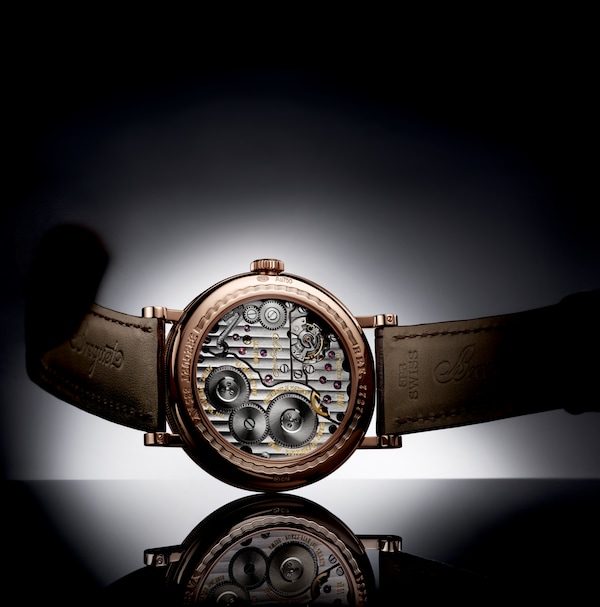
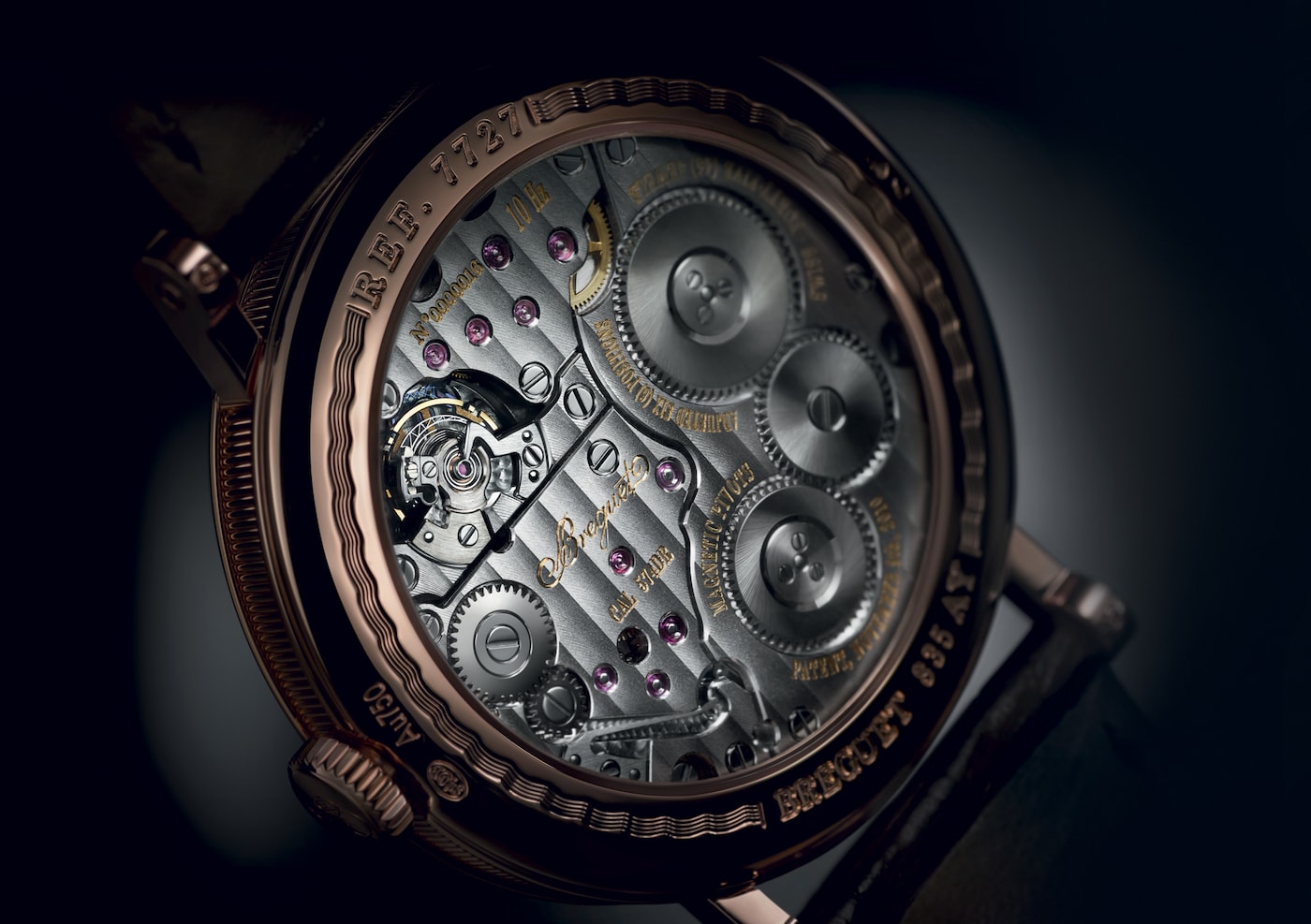
To memorialize this revolutionary construction, the date of the magnetic suspension patent is engraved onto the movement of the Classique Chronométrie. In this there is symmetry with the past, as Breguet’s tourbillons are engraved with the date of that patent, “7 an Messidor 9”, the date expressed under the French revolutionary calendar then in force.
There is a second major innovation which revolutionizes the timekeeping performance of the Classique Chronométrie, high frequency. Movement designers have long since identified the key factors that determine the ability to regulate finely the running rate of a mechanical watch movement. These are the inertia of the balance, its amplitude, which is the number of degrees of its swings back and forth, also termed “oscillation”, and its frequency. Of these three, it is frequency that has the greatest effect, indeed far greater than the other two.
Although there are mathematical formulas that prove the point, the basic concept can be boiled down to a rather simple analogy. If a watch is running at a high frequency, that is to say with each oscillation of the balance wheel occurring relatively quickly, any disturbance to the back and forth swings of the balance wheel will diminish more rapidly than if the oscillations were taking place more slowly, i.e. at a lower frequency. In short, perturbations dissipate more quickly, with less influence on the regulated rate.
Although the benefits of high frequency have been well understood, there have been substantial barriers to designing movements that can usefully run at these higher rates. These obstacles include diminishment of power reserve — imagine, each “tick” of the watch results in an unwinding of the barrel; the faster the rate of the “ticks” the faster the barrel is depleted — wear of components, and deterioration of lubrication. Unable to avoid these downsides to high frequency, the evolution of watch design has been stalled for decades, with essentially all movements operating at frequencies between 18,000 and 28,800 beats per hour, with only a very few limited exceptions running faster.
Breguet equipped the Classique Chronométrie with a frequency of 10 Hz, or 72,000 beats per hour. Its escapement, lever and spiral are fashioned in silicium. This use of silicium in the movement of the 7727 addresses and solves the wear issues that would have arisen with the use of preexisting materials operating at high frequency.

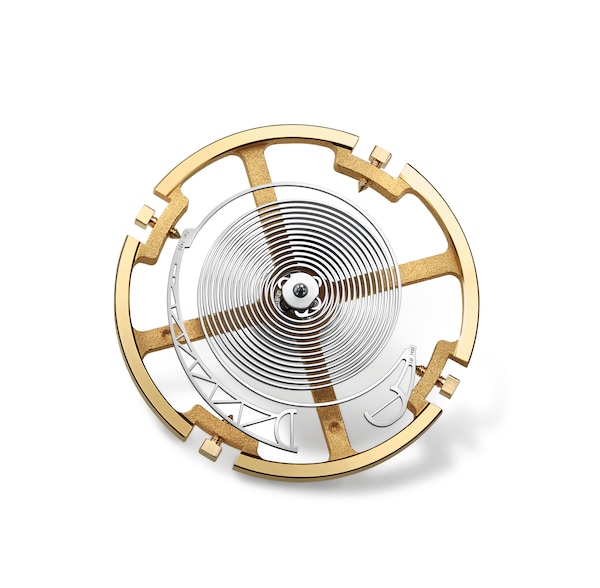
The Chronométrie has taken a further leap ahead as the balance wheel is fitted with not one, but two spirals wound in the same direction and mounted 180 degrees apart from each other. Again the purpose is timekeeping precision. With conventional watch designs, with a few exceptions, there is a single spiral which tightens and untightens as the balance wheel swings back and forth. However, no matter how carefully a conventional single spiral is formed, this winding and unwinding always occurs slightly asymmetrically, which in turn, applies a sideways force against the balance staff. And, you saw this coming, that adversely affects the timing precision of the watch.
The two spirals of the Classique Chronométrie, mounted opposed to each other and expanding and contracting in unison, do so symmetrically, with the balance staff maintained in a center position, of course in the magnetic field. Essentially no net force is exerted on the staff leading to better timing performance.
There is one other completely new element found in the construction of the twin silicium spirals. The outer end of each spiral debuts an entirely new design, which incorporates what in effect is a bridge which, in turn, is attached to a common mounting point. As the bridge is rigid and terminates at its far end with the attachment of the flexible part of the spiral, the outer mounting point of the spiral becomes the end of the bridge. By cleverly shaping the bridge, Breguet’s movement designers were able to position the outer end of the spiral in an ideal location, one which minimizes the deviation from a perfectly circular shape as the spiral winds and unwinds. This Breguet patented bridge design works to minimize this potential source of rate error.
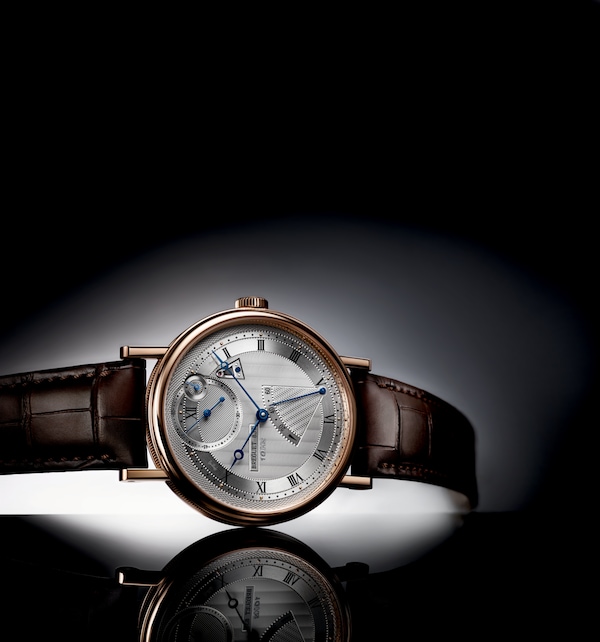
In order to achieve a high power reserve of 60 hours, the Classique Chronométrie employs two winding barrels, mounted on ball bearings and operating in series. Conveniently, a power reserve indication is offered on the dial.
It is easy for one’s head to swim when traversing these game changing movement innovations. But one thing is easy to understand, the results. The Classique Chronométrie is regulated when fully wound to an extraordinarily precise average rate of -1/+3 seconds a day, and, as part of the final control after assembly, each watch’s chronometry will be individually tested with its performance recorded upon an Accuracy Certificate, in the form of a booklet, which will be packaged with the finished watch.
For all of innovation tucked inside its movement, the Classique Chronométrie, as the name suggests, aesthetically, is “classic” Breguet. Even though its interior houses the large amount of energy necessary both to run at a high frequency and achieve an extended power reserve, the refinement of Breguet design is maintained with an elegantly thin, moderate diameter case. The hand guilloche dial borrows a visual style from many of Abraham-Louis Breguet’s pocket watches with the displacement of the chapter ring from the center of the watch.
Three aspects of the dial do embody features not heretofore found. First is the large seconds hand. As a result of the high frequency of the Classique Chronométrie, instead of moving in small little jumps, to the eye, it seemingly glides along its circular path. Second, is the fitting of a supplemental seconds hand. Crafted in silicium, this supplemental hand spins once every two seconds. Finally, the dial has been opened up to allow a view of the upper bridge for the magnetic suspension system.
The Classique Chronométrie is offered in both rose gold and white gold, both versions in 41 mm cases.